The Las Vegas Sun on an iPad and my thoughts on Apple’s latest little fruit

Not that it is a huge surprise to anyone, but earlier this month I was up-and-at-em first thing on the Saturday morning when iPads were available for sale.

It’s not much different from the other photos from that day, but here’s what the scene looked like at the Apple store at Las Vegas’ Town Square:

(Sidenote in regards to the above picture: I’ve noticed people often are surprised when Las Vegas has something that all other big cities have … like an Apple store. It sometimes feels like they think we only have mega-resorts and slot machines, forgetting that nearly 2 million people live here. That said, of the three Apple stores in Las Vegas, the best one to visit — especially when you need to visit the Genius Bar — is the one in Caesars Palace’s Forum Shops. At least in my experience, it’s typically not nearly as busy as the others.)

Anyway …

Later that weekend, I decided I wanted a different iPad case than the one I originally purchased. This gave me a great excuse to go to another Apple store, this time the one inside Caesars Palace that I mentioned above. More than 24 hours after the initial release of the new device, the place still was hopping:

At the Las Vegas Sun, we wanted to have a presence on the iPad for its launch, but didn’t want to blindly build an app that we couldn’t test.

We also kind of wanted to see what worked well on the device before trying to build something for it. And like many other folks we talked to, we decided that simply porting a publication’s print edition over to something that appears to behave like little more than a crippled, illegitimate cousin of a PDF isn’t really the right strategy. (But God bless all of those who are doing something. There is a special place in heaven for you for not standing still and pretending that 1995 is going to return any day now.)

Anyway, all of this meant that we needed to do something with the Sun’s actual website. Our team already is big-time focused on web standards, so we knew that wasn’t going to be the problem.

The problem was going to be that one of the things the Sun does well and has made a substantial commitment to is multimedia journalism. And like a lot of sites, we deliver lots of those elements via Adobe’s Flash plug-in, which obviously pisses off Steve Jobs.

So, straight to the point, we want to keep serving those elements on the Sun’s site when it is visited by a browser that supports Flash. But we also want them to work on the iPad’s great screen.

So, Greenspun Media Group smartguys Danny Debelius and Elliot Burres monkeyed around with our site’s code and tweaked it so it would know when a reader was visiting lasvegassun.com on an iPad and deliver video and photo galleries that not only work on that sucker, but look fantastic in the process.

We’d actually crossed part of this path before because we had worked to make the Sun’s videos compatible on iPhones almost a year ago.

When something can be done without a Herculean effort, and will help us be where our readers might be, why not do it? Just seems like a no-brainer.

This wasn’t a huge two-week process. It was something that we could do fairly easily without getting our programmers involved, etc…

And it all was done before the iPad was even released.

Here’s what lasvegassun.com looks like on an iPad:

+++++++++

The homepage:


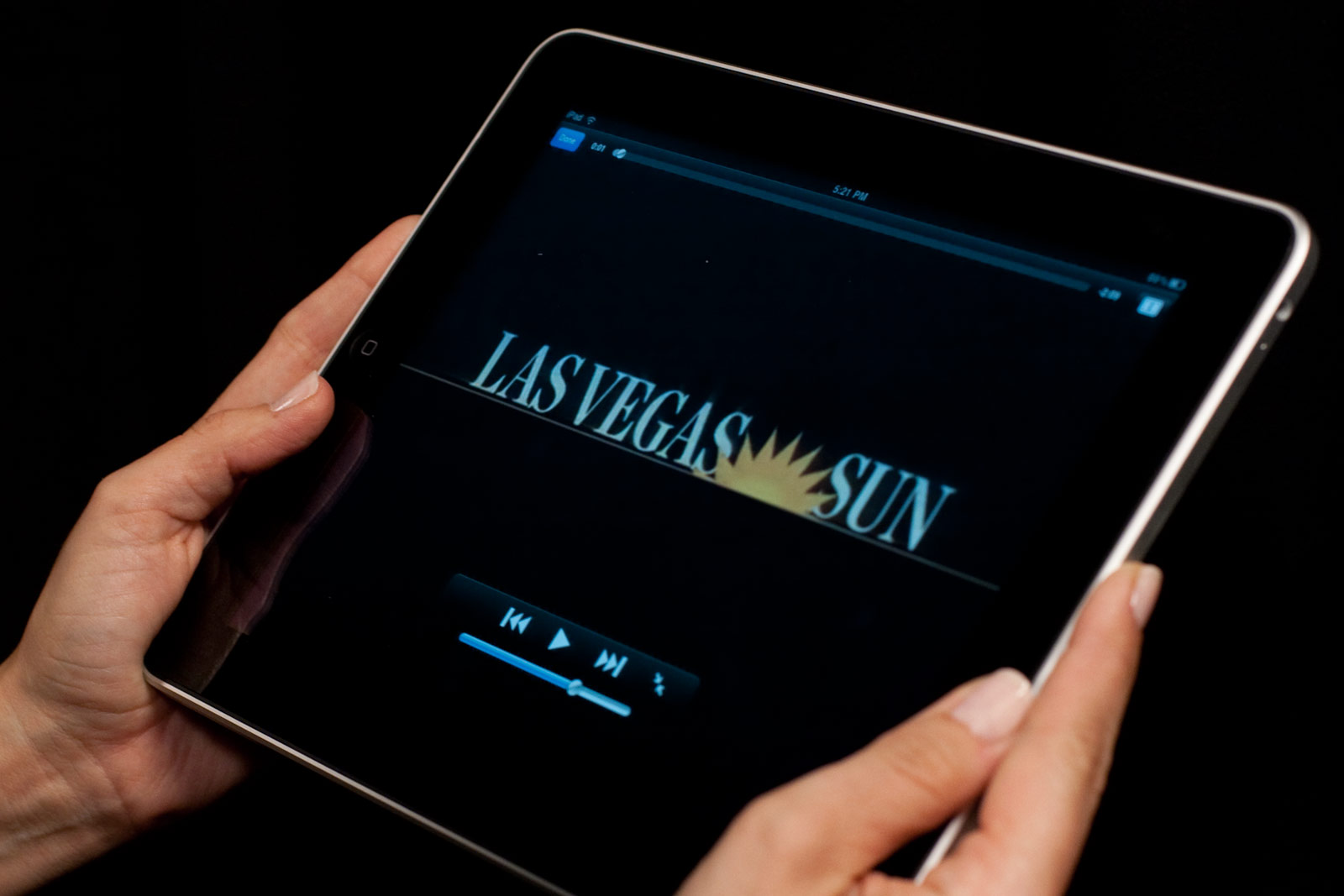
Video player, full screen:
Full-screen photo gallery (with cutline):
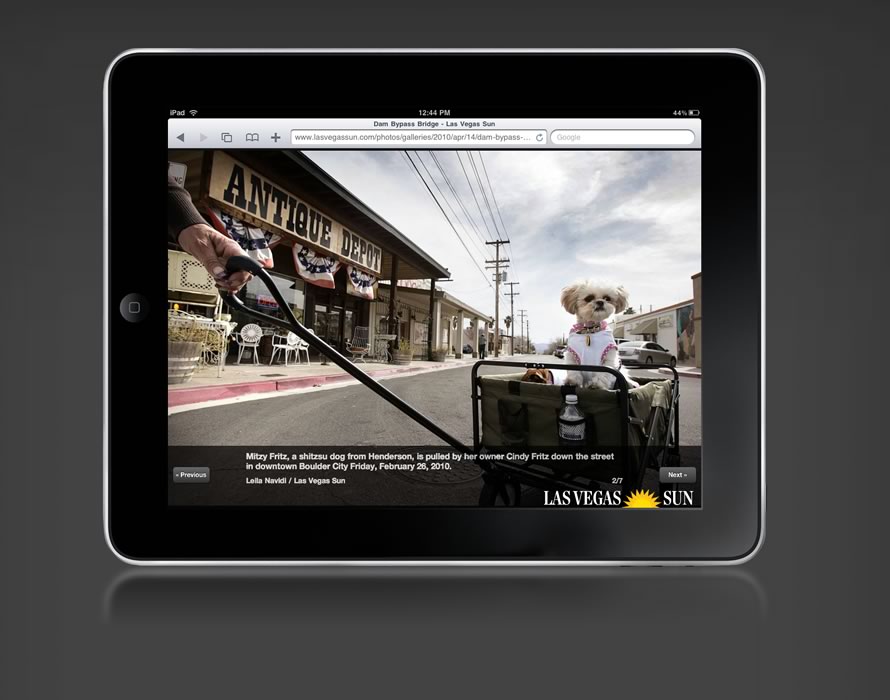
Full-screen photo gallery (you touch the screen to make cutline disappear):

+++++++++

So, what do I think about the iPad?

Well, my reaction is similar to what David Pogue wrote in his “two” different reviews. The iPad falls into two categories for me: Rob, the nerd from Kansas who loves gadgets; and Rob, the person at the Las Vegas Sun charged with helping to take our news forward.

On Twitter, I religiously follow several journalism/tech folks who I respect immensely. Each day, I e-mail myself so many of their tweets (or use Instapaper, which is probably my favorite/most-used app right now) so that I can read/visit them later that it might be borderline obsessive-compulsive.

I’m probably going to oversimplify their general thoughts in an almost embarrassing way that’s surely going to get me called out. But it seems to me like some observers (and folks who, as I’ve already said, I really respect) essentially wonder if the iPad, at the very least, is going to be a huge distraction to the many publishers who think it might save our industry. And at most, that it might be something that ties the industry to Apple, which daily slides closer and closer to something that’s more evil than good.

If these are some of the many points/concerns about the iPad from people who care about the future of journalism, I’m right there with them. The iPad isn’t going to magically fix our industry’s woes. Advertising dollars aren’t going to start rolling back in because we can now pay a little more than $200 for an annual iPad subscription to the Wall Street Journal. And, outside of niche publications, it’s hard to make a convincing case for premium-priced digital subscriptions that can replace circulation revenue.

I suspect some publishers are excited about the iPad because they see it as a device that can approximate a print experience in a digital environment.

Those who think like that *are* distracted. And wrong. (Though I guess many of the folks I know in our industry also probably pray that the revenue-returning hope from iPad will turn out to be true. Of course many of the folks I know back in Kansas hoped Bill Self could win another national championship for the Jayhawks this year, as well.)

So, what does the geek in me think?

I’m definitely not an elitist when it comes to technology, although I personally own enough computers, cell phones, gadgets, etc., that it pretty much looks like an Apple store or a Best Buy vomited in our living room at home.

I own a Mac Powerbook, but the computer I use the most is my MacBook Air — which doesn’t have tons of power or a gazillion ports to plug crap in to. Heck, the “computer” I probably use the most is my iPhone. I’d guess that somewhere close to 85-90 percent of the e-mails I write are done so on my iPhone.

When I got my iPad, I never envisioned it as a replacement for my laptop.

Good thing, because it’s definitely not a laptop. If you need or want a laptop, I think there are some good little machines out there right now at pretty decent prices. Just don’t get the iPad.

The iPad isn’t really a glorified iPod Touch either. It’s more of a cool way to surf the web, watch movies/video, read books and magazines, etc.

After having the iPad now for a little more than two weeks, here’s what I use it for:

• I’m on the web with it a lot. As stupid as this is going to sound, it’s just fun to visit sites with this thing and it is quickly becoming my preferred way of surfing the web when I’m at home.

• The MLB “At Bat 2010” app is amazing. I use it all of the time to follow the Kansas City Royals, who appear to suck again this year. Watching game highlights on the iPad via this app is great, and MLB does a great job keeping info/video/stories flowing in a very timely manner.

• I have recently started using the “Things” app across my desktop computer, iPad and iPhone in an effort to try like crazy to keep myself on task. Early results are that it seems to be helping, and I use it a lot.

• Like a lot of people I know, I prefer the Amazon Kindle app to the Apple iBooks app. The iBook app is slicker, no doubt. But the Kindle app works better for me across different platforms, and when I’m looking for a book, Amazon has it and Apple usually doesn’t. I understand that many of these things could change, but as of April 21, I use the Kindle app way more often than I do the iBooks app.

Instapaper. Probably my most-used app. I have it tied to all of my browsers on all of my machines, as well as tied to my Twitter apps. Indispensable.

Netflix. I know I’m a dork because our family never had a Netflix account until we got an iPad. Now, we have a Netflix account via the iPad app and we still don’t have a single movie in our delivery queue, yet it is probably the app used the most by our family. Our sons have watched 10 streaming movies and many of those movies more than once. The movies look surprisingly great on the iPad, despite being streamed.

• We have tons of “traditional” media/news apps on our iPad — Wall Street Journal, USA Today, Time, GQ, Guardian Eyewitness, NY Times Editors’ Choice, NPR, Popular Science, AP News, Maxim, Thomson Reuters News Pro, etc. Just like on my iPhone, the news app I go to the most on the iPad is the USA Today app. I like many aspects about the others, but not enough to use them much. To me, at first blush, the most interesting magazine implementations at the moment are from Popular Science and Maxim. But at least for right now, when I want news, I still go to the web for it. Unless it’s baseball news. Then I go to the MLB app.

• We have several movies loaded onto our iPad via iTunes and they look and sound fantastic. This week, I had my first major travel/flights since I got the iPad and it was a fantastic experience in just about every way.

• We have two younger sons (8 and 3) and they use our iPad a lot. We have numerous drawing and coloring apps (Chalk, Draw, ArtStudio, Color&Draw, etc…), which are all a big hit with them. We also have the free Toy Story eBook, which also has some games and coloring activities inside of it, which they love.

• I also have found that when I am at home, I am more likely to check my e-mail on my iPad than on a computer.

You can write on it (answer short e-mails) but you’re not going to want to do much of that. I tried to write some contest entries on it last week and quickly gave up. And as cool as the “Pages” word-processing app is, it still seems like a total pain to get content in and out of it. My conclusion is I’m definitely not going to want to write anything long on this baby.

The iPad definitely feels like something new to me. Like many folks already have said, it is primarily a media-consumption device. And that ticks some people off. Not me. My expectations were pretty managed.

As my friend and mentor Bob Cauthorn says, it’s an “information appliance.” It does certain things well. But not everything. You don’t get pissed when your toaster can’t bake a turkey, yet it seems like some people can’t get over what an iPad can’t do.

I’m not one of those people.

I’d say the iPad is more like something you relax with in a comfy chair, not sit at a desk or a table with. My initial thoughts are that I really like it. The things that it does, it does really well. And it’s just fun to use — that’s an intangible that goes beyond its power and ports.

But it’s definitely not a laptop or even a netbook. And, outside the obvious of not being able to make phone calls (which I can just barely do on my iPhone, anyway), I’m noticing that I use the iPad much differently than I do the iPhone.

When I use my iPhone, I tend to use apps. In most circumstances, apps seem more practical (and quicker) for me to use than going to the Safari browser on the iPhone. But I’m noticing that on the iPad, I’m much more likely to just use the web.

I have the New York Times iPad app, but unless I’m on an airplane without an internet connection, I’m much more likely to visit the Times’ website.

However, just because that’s how I use it, doesn’t mean that is how everyone will use it. An interesting point from one analyst was that the “power of the iPad is it is multiple things to different people. If you ask five people, you get five answers.”

And I’m fairly certain it’s not the savior for newspapers or magazines. (Though I do think some magazines ultimately will look badass on this baby.)

For newspapers to get it right, especially if they’re going to go the route of an iPad app, I suspect they need to think more like how ESPN appears to think when it moves to a different platform.

Look at how great ESPN is as they design different experiences across so many different media:

• On TV, ESPN means game coverage via traditional live broadcast capabilities and great post-game coverage via “SportsCenter” and “Baseball Tonight.”

• In print, ESPN magazine means great photos, longer features and analysis pieces.

• On radio, lots of talk shows, interviews, punditry and — of course — live game broadcasts.

• Online, ESPN.com pulls together all of these appropriate elements but does it in a way that typically feels pretty webby to me. It does a fantastic job with breaking news on the big, national stories. And though I can’t pass judgment on its local sites because I’m not really a fan of the teams where it has local sites, its numbers are impressive in those markets.

• ESPN on the iPad also feels like their brand customized one more time for a different medium/platform. I have the ESPN iPad customized for the Royals, Jayhawks and UNLV Rebels. And although I don’t go to it daily, I do use it at least a couple of times a week.

I think in a lot of ways, ESPN really “gets it.” It’s an organization that understands that its brand — though always clearly about sports — is defined differently in different platforms/media.

I don’t feel like very many newspapers understand this. Just because you do one thing in print doesn’t mean you do the exact same thing on the web or on mobile devices. Or now on an iPad. (Please don’t read into this that I feel like newspapers should build iPad apps solely around personal customization, like ESPN did with its app. However, I do think newspapers shouldn’t blindly just do the exact same things across all platforms and call it good.)

There is a difference between re-purposing your content and re-imagining your content. Smart newspapers will re-imagine their content to exploit different platforms rather than simply re-purposing.

As I mentioned earlier, the iPad feels like a media-consumption device. And at a minimum, I feel it’s a little irresponsible not to make sure that your news organization’s web content works correctly on it. You don’t have to build a dedicated app if you lack the resources, but at least get your website working well.

In this day and age, our goal at the Sun is to reach our audience wherever it might be. And we’re certain that some of our audience will be on an iPad. Analyst estimates on iPad sales vary, but many fall in the 3 million to 7 million range for the first year and expand to as many as 20 million new sales in 2011. And that’s just the iPad, not the whole universe of tablets that are in the pipeline.

Getting involved early is smart. In 1995, the world’s Internet population was 16 million (that’s less than the number of iPads some are predicting to be sold in 2011 …). In just four years global internet users had grown from 16 million to 248 million.

That’s a lot of change … and you can either participate in it or watch it from the sidelines.

Internet-connected mobile use is hugely important for our industry and it’s a mistake not to be active in this space. In three years, the iPhone and iPod Touch went from zero to 75 million users. In just a few years, the Apple app universe went from zero downloads to 3 billion downloads. When an attractive new platform arrives, people adopt it quickly.

So it’s really not that complicated: If this is where our readers are going to be, we should be there, too.

And the Las Vegas Sun is. We’re just not tying huge revenue expectations to it.

+++

To comment on this post, or to see comments about this post, please go here. (Requires Facebook account.)

Internships at the Las Vegas Sun and the Greenspun Newsroom

This is basically a re-post of a re-post that I’ve posted for the last couple of years. The reason for all of this repetition is simple: We’re looking for a few talented interns to join our team at the Greenspun Newsroom for the summer and even through next spring.

Greenspun Newsroom

+++

The Las Vegas Sun and the converged newsroom at Greenspun Media Group are looking for interns who want to get real-world, practical experience with coverage of local news and business, and entertainment (yes, that very well could mean The Strip, the celebrity side of Las Vegas and our cityÒ€ℒs crazy club scene).

What does that really mean?

It means weÒ€ℒre looking for at least a couple of people to help with development and research for enterprise and investigative stories for the Las Vegas Sun, the news and sports side of lasvegassun.com, as well as all of the cool things happening over on lasvegasweekly.com. And if an amazing/hard-working visual journalist or programmer applied, well, we would have to consider finding someone like that a position.

We want solid journalists who can write their backsides off and who arenÒ€ℒt afraid of multimedia or working directly with a fairly sophisticated online content management system (or CMS, as the kids love to call this sort of software).

Solid grammar knowledge and writing skills are a must. The selected interns must be effective communicators on the phone and in person and be able to conduct interviews, research and write stories with minimal supervision. They must be receptive to editing and coaching and be able to take instruction when working in collaboration with full-time staff members.

Above all else, the students or recent graduates will demonstrate maturity and critical-thinking skills, show exuberance toward the career of journalism, and embrace its values of accuracy and fairness.

These are “fiber-cyber” internships, with equal focus on the analytical journalism featured in the Sun print edition, the breaking news featured on lasvegassun.com and the local-lifestyle journalism that makes up Las Vegas Weekly and lasvegasweekly.com.

+++

Here are some answers to a few basic questions about these internships:

* How long do these internships last? A minimum of roughly three months and up to nine months.

* Are they paid internships? Yes. But just barely. You arenÒ€ℒt going to get rich. But youÒ€ℒll definitely be able to get by.

* Am I going to fetch coffee? No.

* Am I going to have to do some data-entry? Yes, just like the full-timers on our staff have to do. And if you get the internship focused on the SunÒ€ℒs enterprise journalism, this sort of work will definitely be a part of your weekly routine.

* Am I going to work harder than I ever have at any other point in my life? Likely. Unless you’re from Kansas, and then it will be basically what you’re already used to. πŸ™‚

* What skills do I need? You need to be able to write your tailfeathers off, and generally be the most self-motivated student in your J-school. We want to hear from applicants who have taken the initiative to learn more Ò€” even if that Ò€œmoreÒ€ only consists of basic audio-editing skills, basic video-editing skills, basic HTML knowledge, at least some knowledge of Internet journalism, maintaining a blog, etc.

During our intern interviews, we always hear something like this: Ò€œI can write, but I donÒ€ℒt really know anything about Web journalism. I really think this internship would help teach me those skills.Ò€

Well, teaching new skills is wonderful and we love to do it, but in this era, we want students who have learned (and in many cases, taught themselves) at least some skills related to new-media journalism. If all you can do is write Ò€” which is a hugely important skill to our team Ò€” then you probably arenÒ€ℒt interested enough in the type of journalism that we practice at the Las Vegas Sun, lasvegassun.com and lasvegasweekly.com to have learned other things needed to be a part of our news organization.

And you probably arenÒ€ℒt the kind of self-motivated student weÒ€ℒre looking for.

* Am I going to use a real content management system, work with multimedia, as well as do a bunch of other nerdy news things that will likely make me the most employable member of my graduating class? Definitely.

* Do I need a car? Yes. Your work will take you all around the Las Vegas Valley, and our communityÒ€ℒs public transportation isnÒ€ℒt going to be enough to get you where you will need to go.

+++

To apply, please click here.

Commode convergence

Sometime in the future, I’ll probably look back at this post and wonder what I was thinking when I wrote it, and maybe even regret that it’s in my blog’s archives, but who cares?

Live a little. πŸ™‚

Big-time convergence doesn’t have to be reserved for just big-time stories. (If you’d like to see examples of convergence/multimedia journalism that will warm the cockles of your favorite journalism professor’s heart, there is definitely some here.)

A few weeks ago in one of our editorial meetings for lasvegasweekly.com, our nightlife reporter — Deanna Rilling — pitched a story on the extravagant women’s bathroom at the new nightclub inside the Hard Rock Hotel.

As the discussion continued for what initially was thought to be an online-only story about Vegas’ latest preposterous party potty, it was pointed out that there were some other really out-there bathrooms in our town’s nightlife scene. Next thing you know, we’re planning a list of five bitchin’ bathrooms, complete with a huge photo gallery and a video.

Then at one of our weekly group editorial meetings — which includes the top editors from Vegas, our luxury magazine, the Las Vegas Magazine, which is for tourists and is found in most hotel rooms in this city, the Las Vegas Weekly alternative/local lifestyle publication, all of our company’s different editorial websites, and, of course, the Las Vegas Sun — it was decided it would be fun to play a lighter (but interesting) story like this across all of Greenspun Media Group’s titles.

For many of our readers, the story was probably first seen in this morning’s Las Vegas Sun print edition:

+++

+++

Or on our newspaper’s website:

+++

+++

The Sun’s take on the story was written by one of our business/gaming journalists, Amanda Finnegan, and was much more about the business of building something like this and how something so expensive is cost-justified in these times of constant focus on ROI.

Online, Amanda’s story included lots of links to photos of the rooms referenced in the story, as well as a huge (and very fun) gallery shot by staff photographer Leila Navidi, with an assist to staff photographer Steve Marcus.

This week’s issue of Las Vegas Weekly also came out today. Here is the cover:

+++

+++

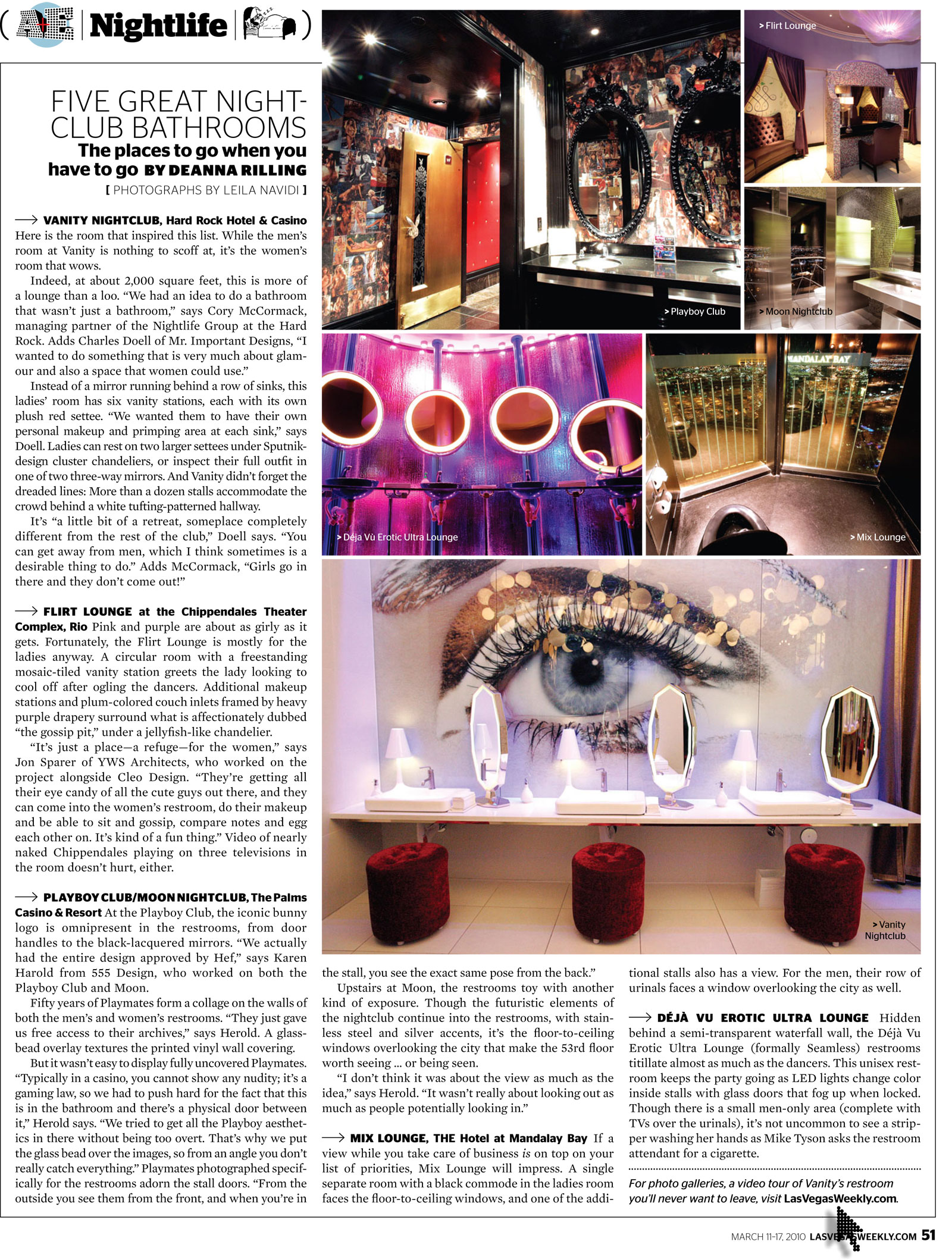
And on Page 51 was Deanna’s story on the five coolest club bathrooms in Las Vegas. It looked like this:

+++

+++

On the homepage of lasvegasweekly.com, the story was played like this (with a totally great/appropriate headline for that site):

+++

+++

The lasvegasweekly.com package also had Leila’s great photos, including a few images that were a little too racy for the Sun’s site.

Both sites also ran this cool and informative video package from Greenspun videographer Trent Ogle on the bathroom at the Vanity nightclub, which is probably the king (queen?) of the overkill Vegas crappers.

+++

http://media.lasvegassun.com/media/assets/swf/mvc_video_2.1.swf

+++

The other publications produced out of the Greenspun Newsroom — Vegas magazine and Las Vegas Magazine — also are planning to run at least some of the photos from this package in upcoming issues.

What’s even goofier about this story/package (can you believe that it actually can get goofier?) is that our company’s marketing/PR division got involved with it once it was done and issued a press release about it this morning. As of 5 p.m. today, two television stations had picked it up. The expectation is that more will.

Our readers seemed to enjoy the story, as it didn’t take long for it to break into our Top 10 most-read list today.

Look, I’m not even trying to pretend that this is groundbreaking or a story that matters. It’s not. I know that. And you know that.

But doing something like this on Sin City’s sh*tters was a lot of fun and a great exercise in working together. Finding the different angles that were appropriate for each publication and platform was an interesting exercise for us.

Now, please excuse me, I need to go see what it’s like to “visit the office” with an inspiring panoramic view. πŸ™‚

+++

To comment on this post, or to see comments about this post, please go here. (Requires Facebook account.)

The evolution of lasvegassun.com’s homepage strategy — more importantly, does a nice design negatively impact traffic?

Dating back to our online team’s time in Lawrence, I’ve always had a nice friendship with John Temple. And shortly after our decision was made to come to Las Vegas to work with the Greenspun family of publications, John gave me lots of advice.

His advice that keeps proving to be correct time after time is that we should track and benchmark everything. About 15 or 16 months ago, I blogged about how we used that advice to keep tweaking our content strategy. By watching what our readers really do on our site — as opposed to what they might say in some formal reader survey — we continue to refine it nearly every day.

But we use benchmarking for more than just content decisions.

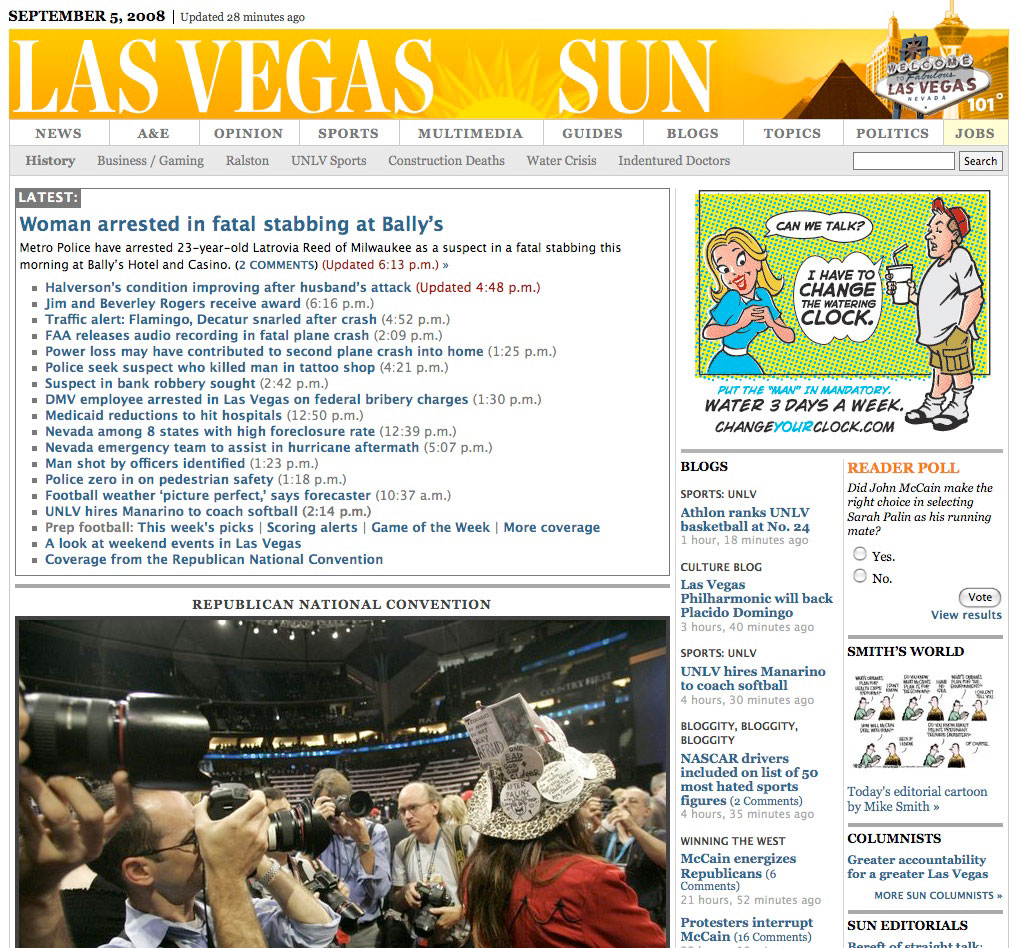
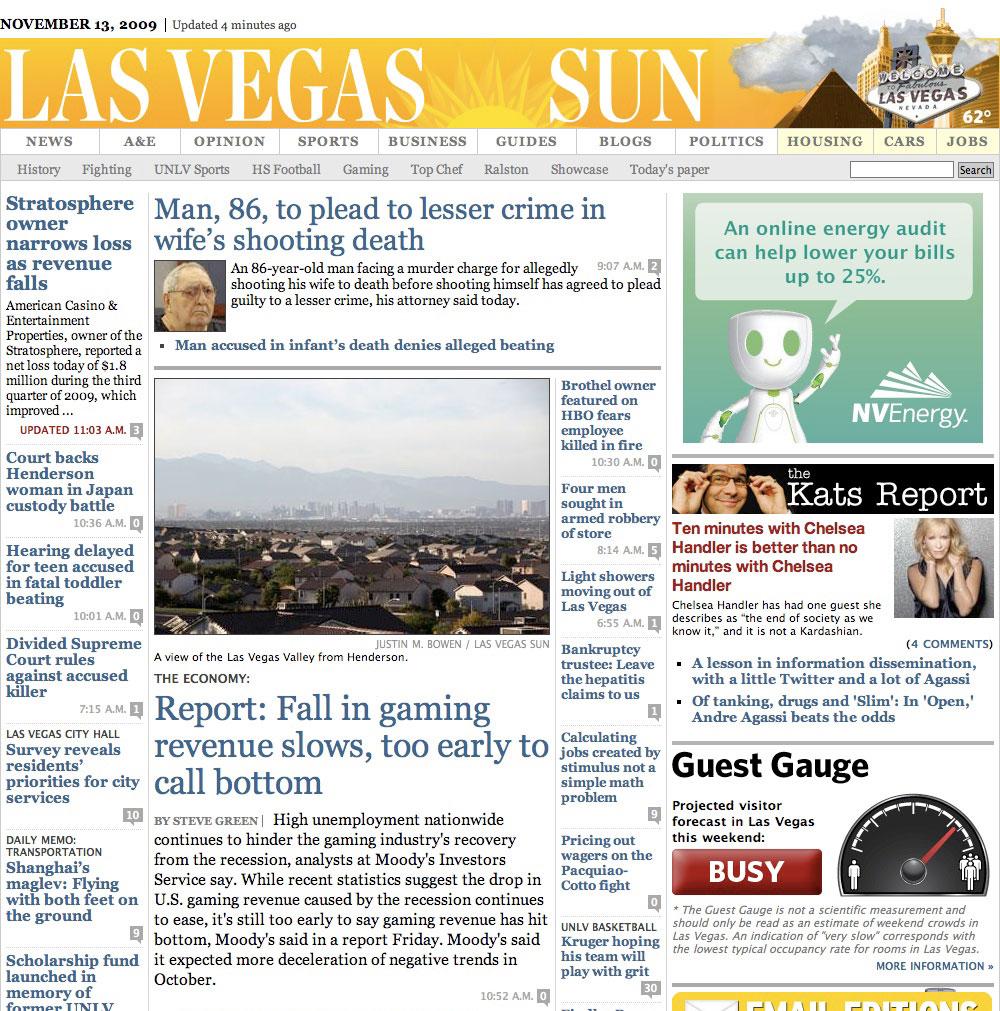
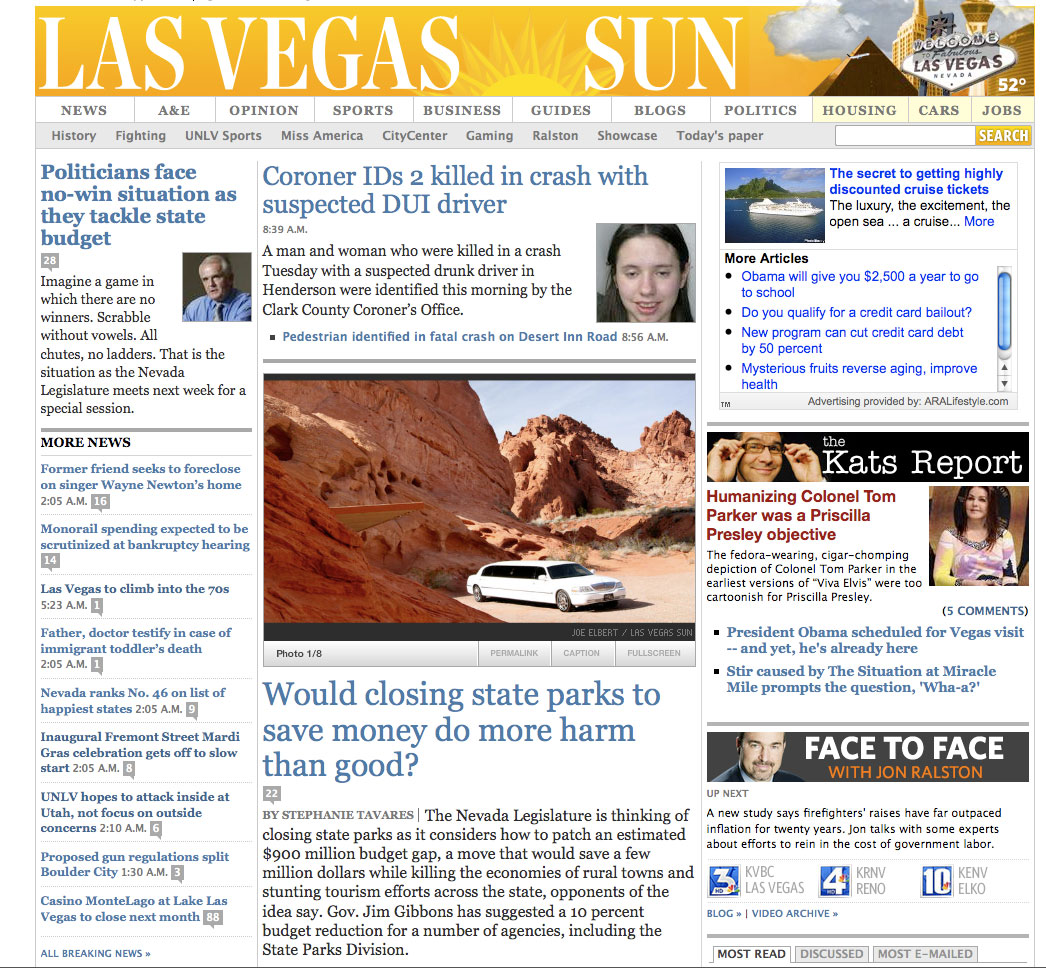
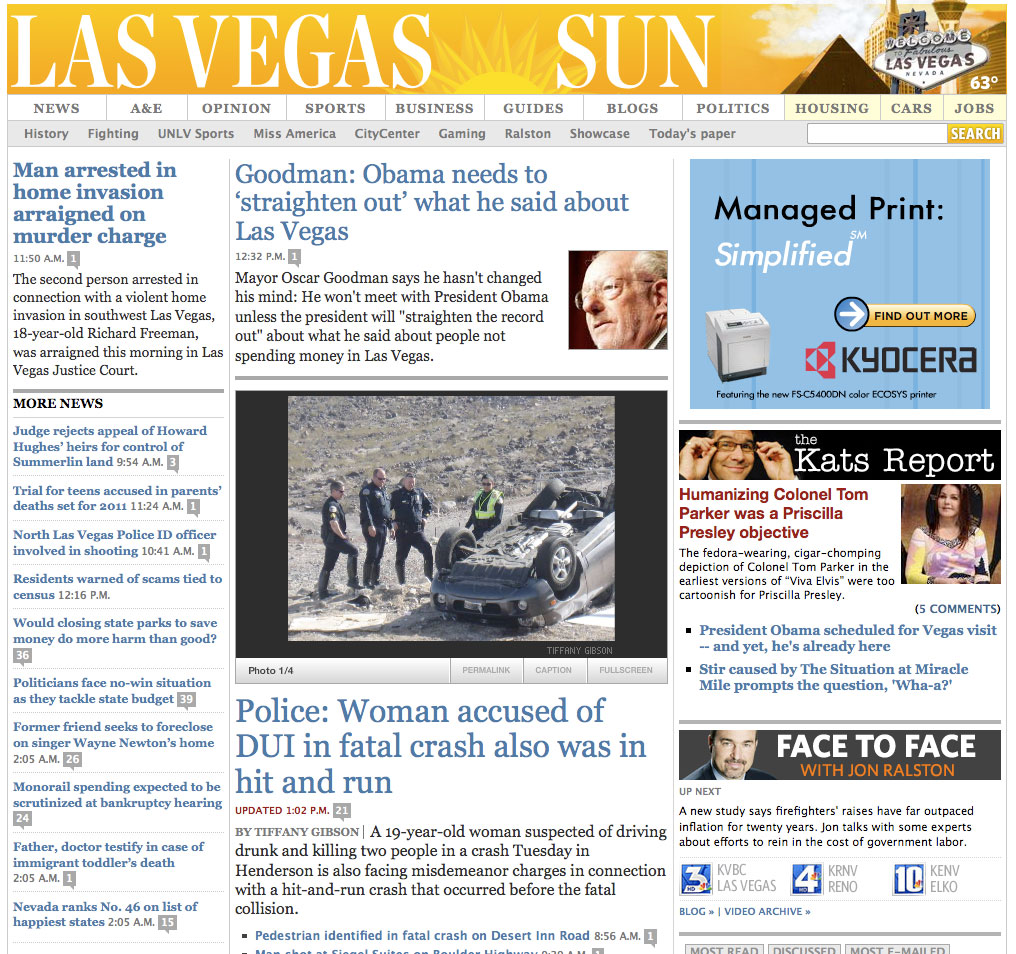
By my math — which, admittedly, completely sucks — the Sun’s homepage design/strategy has gone through roughly four fairly significant changes in the last couple of years.

When lasvegassun.com formally relaunched just over two years ago (under the direction and inspired leadership of Josh Williams, Doug Twyman and Dave Toplikar, along with lots of design love from Bill Gaspard and Tyson Evans), the site’s content closely mirrored the print edition of the Sun. I often describe that version of lasvegassun.com as similar to a very well done, regional version of Slate … not so much the news of the day, but more of what the news of the day meant, along with lots of interesting commentary and tidbits not typically found in a local newspaper.

Because that meant lasvegassun.com had a fairly low daily story count (think around 10 stories or so a day), the main content area of the homepage was essentially designed every day.

And it was a thing of beauty:

+++

+++

Here’s how that main content area would change from day-to-day:

+++

+++

After watching the traffic trends for a few months — including the realization that lasvegassun.com’s traffic numbers were actually going down a little after the removal of some national wire feeds that were being read by a small, but passionate national audience — it was decided the content from the Sun’s print edition was great on the web, but couldn’t be the only thing on the Sun’s website.

Seems kind of obvious now, huh?

At that point, local breaking news and other content created specifically for the web became a key part of lasvegassun.com’s strategy. With that additional content, the site’s traffic numbers began growing very quickly.

The problem was the site’s homepage and CMS templates weren’t really designed for that mission. To accommodate this, the site’s homepage design was essentially hacked. That meant the site had its great-looking print content (which was still being custom designed each day) on the homepage with breaking news headlines just stacked on top.

It looked like poop. It looked like this:

+++

+++

Around this same time (September of 2008), I was asked to speak at an SND conference. I explained this dilemma to the audience and that it looked like we were getting ready to benchmark whether “pretty or ugly” was more practical on the web.

I remember thinking at the time that “ugly” was going to win out because of the amazing traffic that some of the ugliest sites on the web got at that time — think DrudgeReport and you’ll know exactly what I’m talking about.

So our senior online news designer at the time, Tyson Evans, (who also had a very big hand in the design of the site the first time around) began building a tweaked homepage that would hold all of our breaking news.

It looked basically like this:

+++

Las Vegas Sun home page

+++

So, what was the effect on our traffic?

The numbers just kept growing. And because our marketing and better promotion within the Sun print edition really were starting to kick in, the numbers actually were growing fairly significantly.

The weird thing was that we all kind of missed how the old lasvegassun.com homepage would actually be redesigned each morning. The problem was that on top of our content from the print edition, we now were publishing somewhere between 20 and 40 locally produced online/breaking stories a day.

Some of those online-only stories had art. Most didn’t. Some stories were important. A lot were just “new” news, but definitely not huge news.

We certainly weren’t going to be able to custom design homepages with all of those variables.

But with the help of some very creative template implementation by our team’s current (and incredibly talented) senior designer Danny DeBelius, the problem not only was solved but also helped our traffic grow one more time.

The cool part about how Danny built our homepage templates is that our homepage design actually changes several times throughout the day, always looking fresh … and not just because of the newer stories.

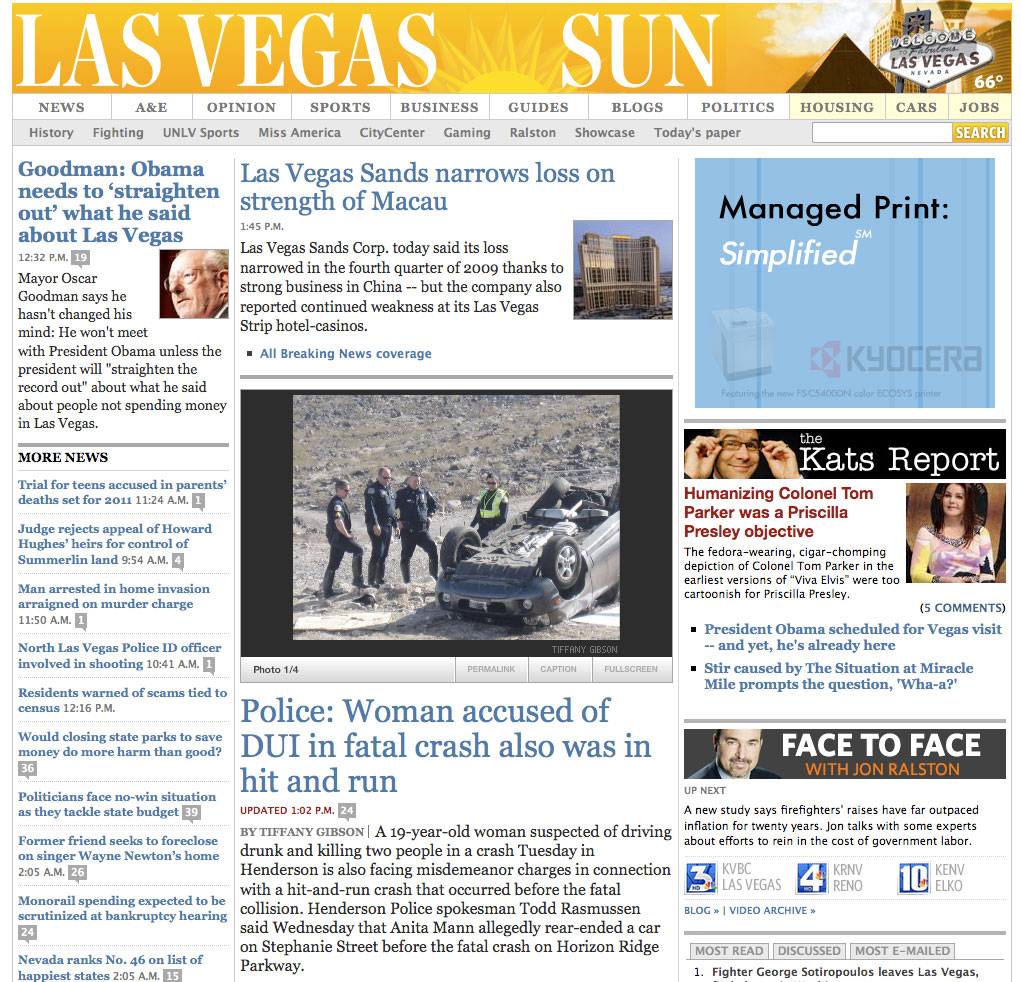
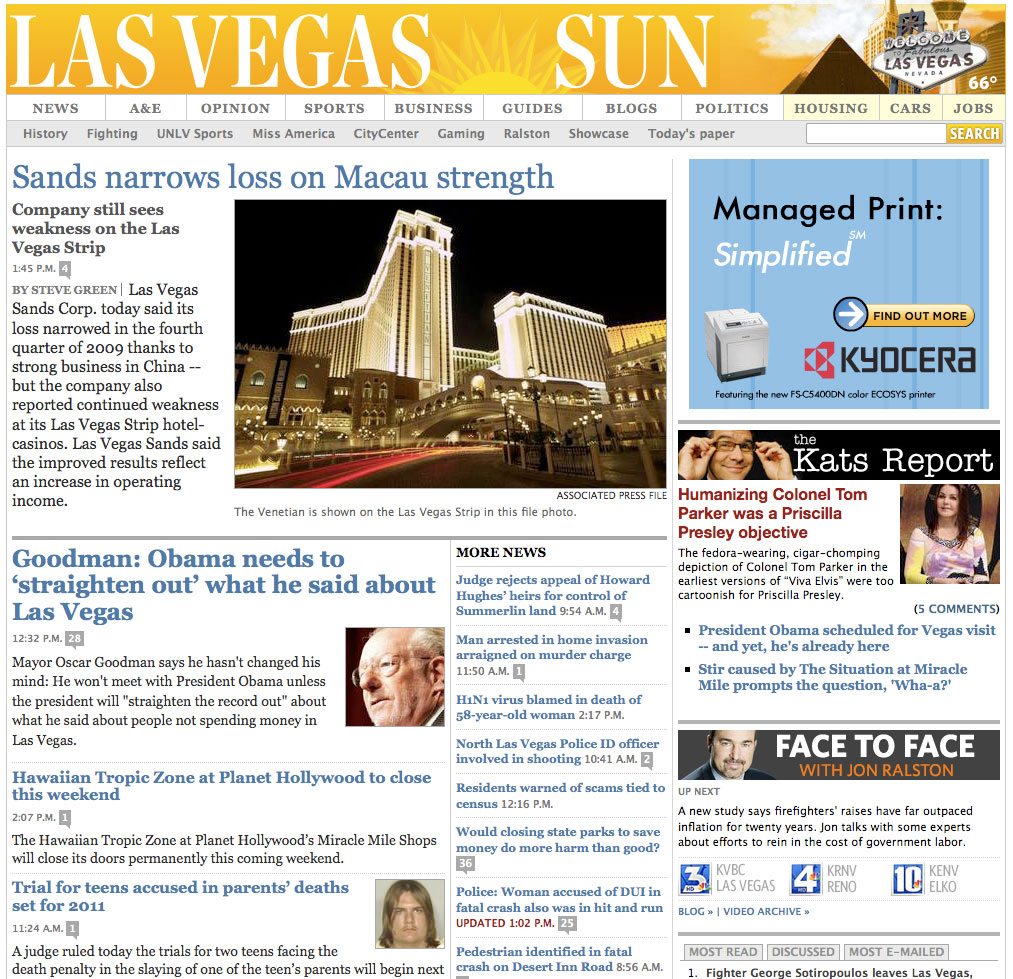
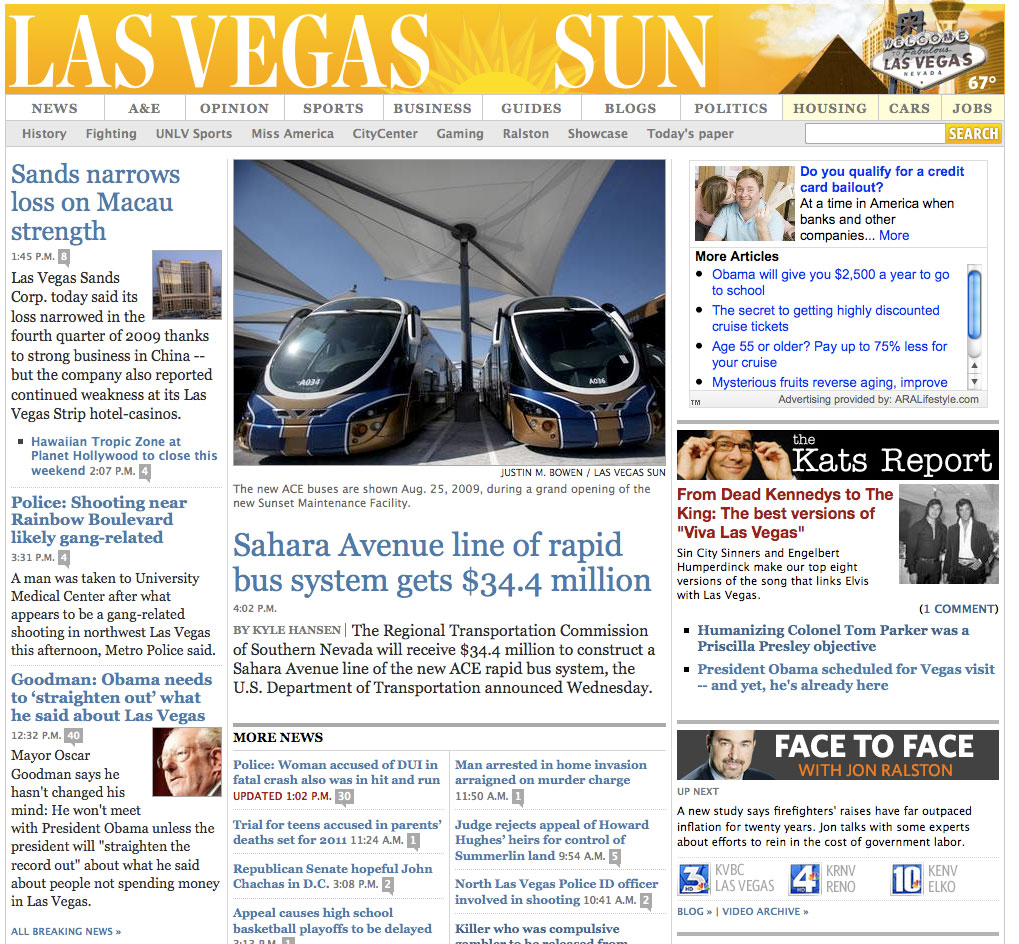
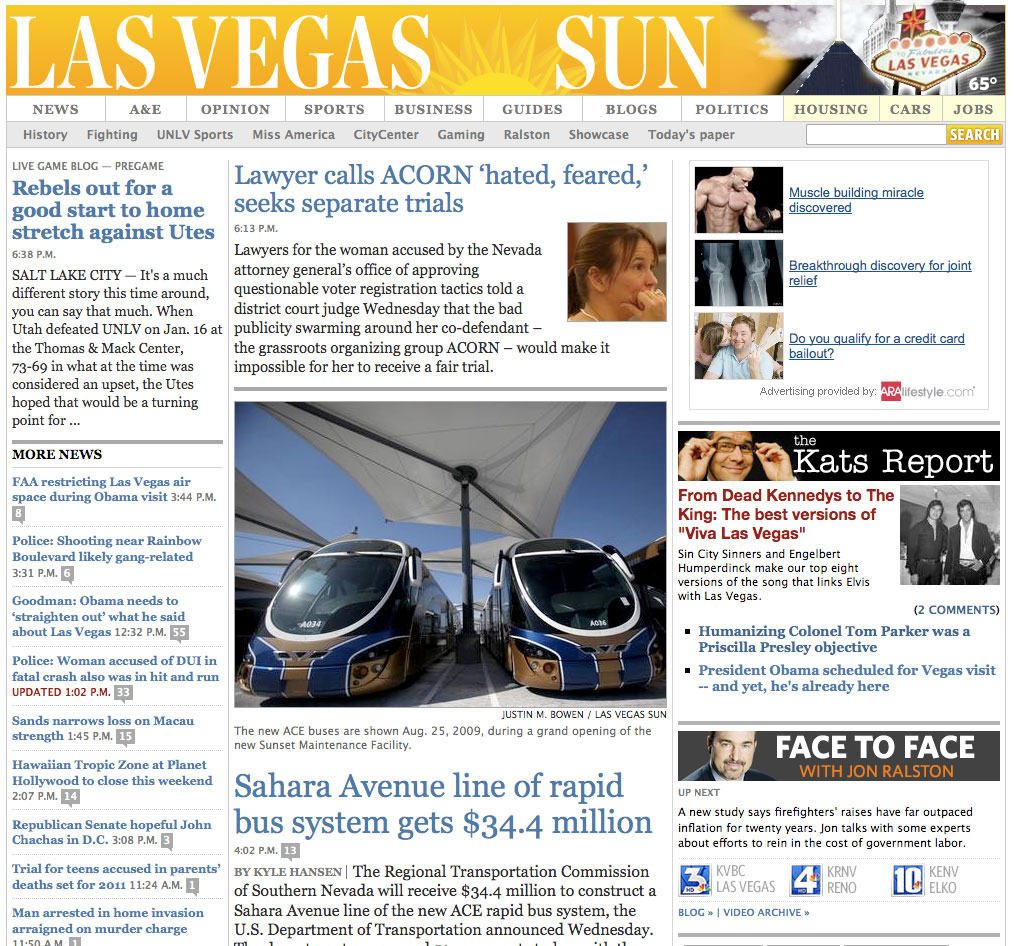
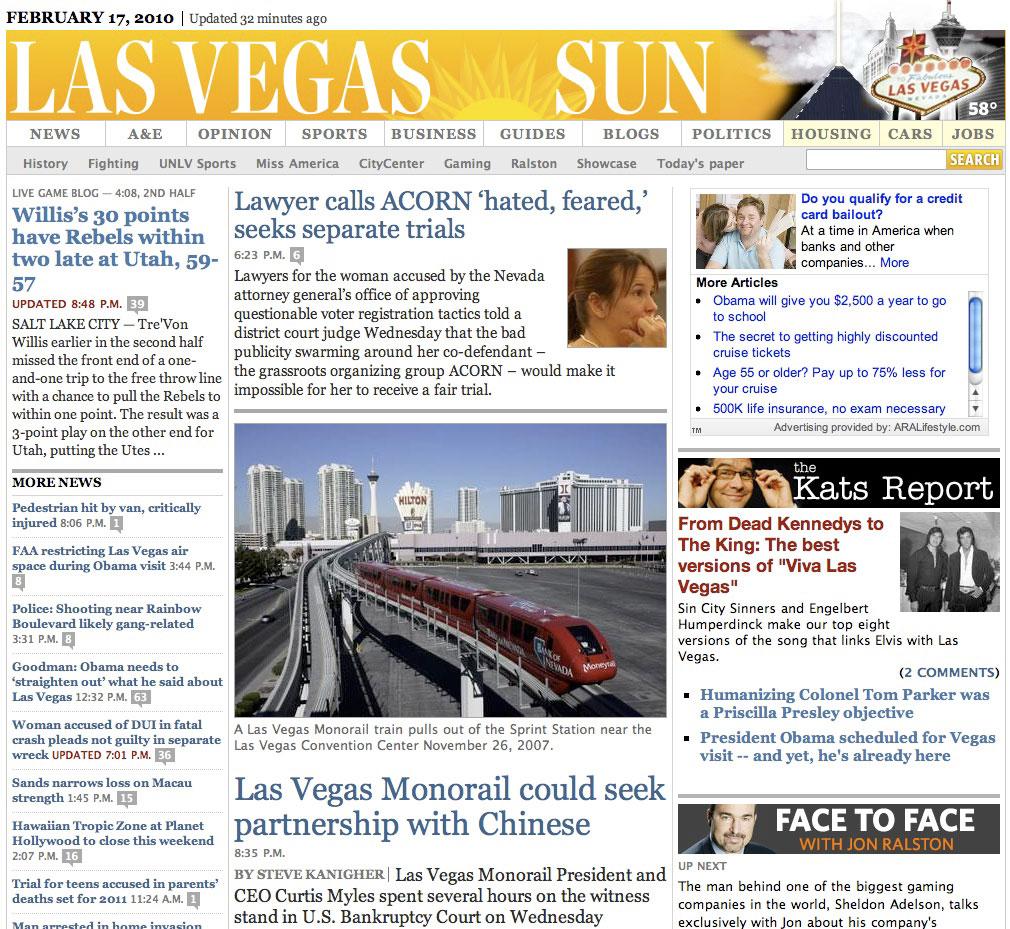
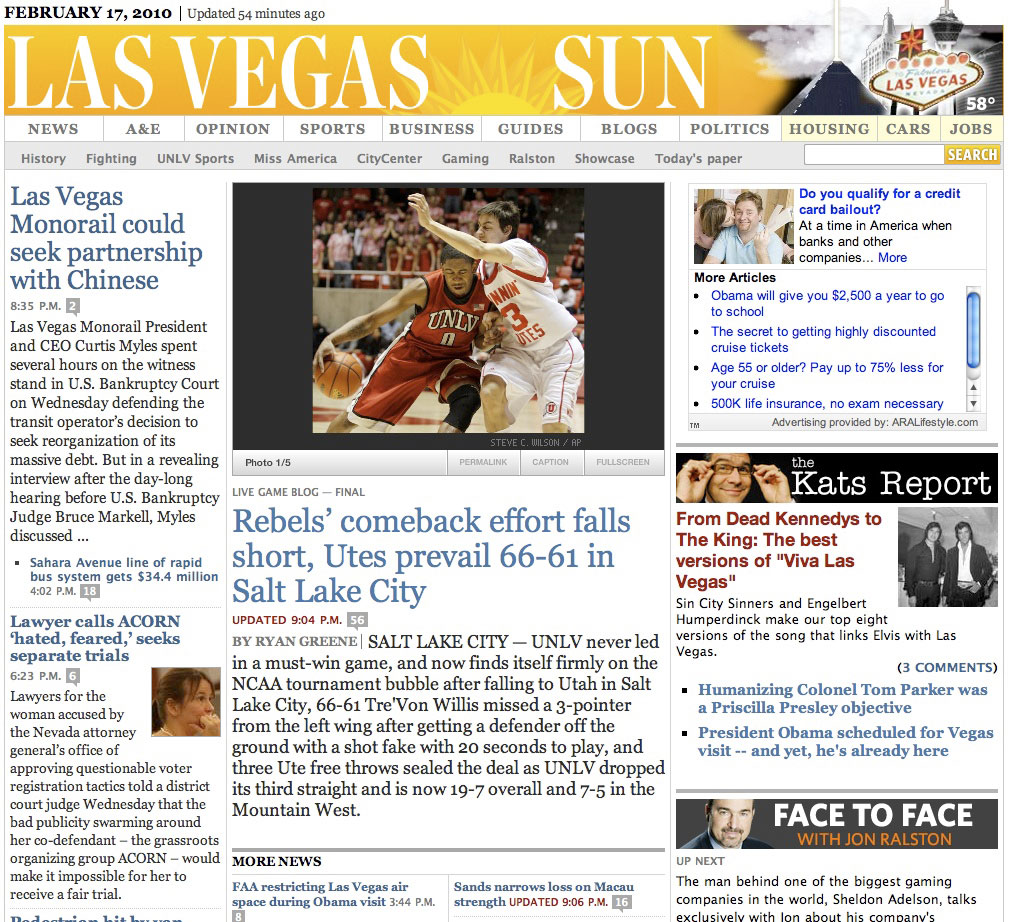
So, here’s a look at how our homepage looked on a recent day — for a 24-hour period beginning at 2 a.m.:

+++

2 a.m., Feb. 17.

+++

8:40 a.m., Feb. 17.

+++

10 a.m., Feb. 17.

+++

11:30 a.m., Feb. 17.

+++

12:45 p.m., Feb. 17.

+++

1:45 p.m., Feb. 17.

+++

2:30 p.m., Feb. 17.

+++

4:05 p.m., Feb. 17.

+++

6:15 p.m., Feb. 17.

+++

8:50 p.m., Feb. 17.

+++

9:05 p.m., Feb. 17.

+++

9:35 p.m., Feb. 17.

+++

We also have what we call our “holy sh*t” homepage template, which we’ve used only twice since we began changing the homepage design throughout the day. (We started using the multiple-design version of the homepage on Jan. 20.)

+++

So, what does this all mean?

Well, we learned that a pretty and practical homepage design combined with the right content mix has led to the most significant online traffic gains of any site our online team has worked at.

We even learned that changing up the design throughout the day doesn’t hurt traffic, despite some traditional online-news design thinking/perception being that you should always leave everything in the exact same place. (Which, BTW, is the dumbest thing I’ve ever heard. I mean, look at how the design of the front page of a newspaper changes everyday, yet everyone seems to pretty much get that concept. Give your readers some credit. Heck, it might even open their eyes to content they wouldn’t normally view.)

We’ve been doing the multiple designs of the Sun’s homepage throughout the day for about six or seven weeks, and our traffic continues to trend upward, with the most obvious lesson being that a breaking-news story with a killer photo gets a whole helluva lot of pageviews, especially when you have a design that blows both out.

More importantly, we can be much more agile with our design based upon our daily content production.

(Though I should note that we’re really only changing up the main content area of the homepage. The navigation and other core elements of the site are always staying in the same places.)

And we know all of these things because we’ve benchmarked nearly everything from Day One.

Thank you, John Temple for the great advice.

+++

To comment on this post, or to see comments about this post, please go here. (Requires Facebook account.)

Weekend in Vegas: Some nifty examples of converged cross-platform/multimedia journalism

This past weekend was interesting here in Las Vegas as a lot of very different types of stories were swirling around us — President Obama was in town, a new Cirque du Soleil show opened, a huge new section was launched on our site, the city’s hot-and-cold Rebels played basketball and a massive multimedia joint effort to explain Nevada’s budget woes ran across all of the Las Vegas Sun’s platforms.

Convergence wasn’t a buzzword this past weekend — it was the type of journalism the Sun was actually committing.

Even though this blog post is mostly about our weekend coverage, for us this story actually began Thursday as folks waited for tickets to see President Obama speak at a local high school. We quickly posted a story and photo gallery of the spectacle, with hundreds waiting in line for tickets to the presidential forum.

(This was all published online as a constantly developing story that was updated throughout the day. That’s a fancy way of saying we kept updating the same story page instead of having several different stories on our site, this way readers could keep visiting the same story page for the latest news.)

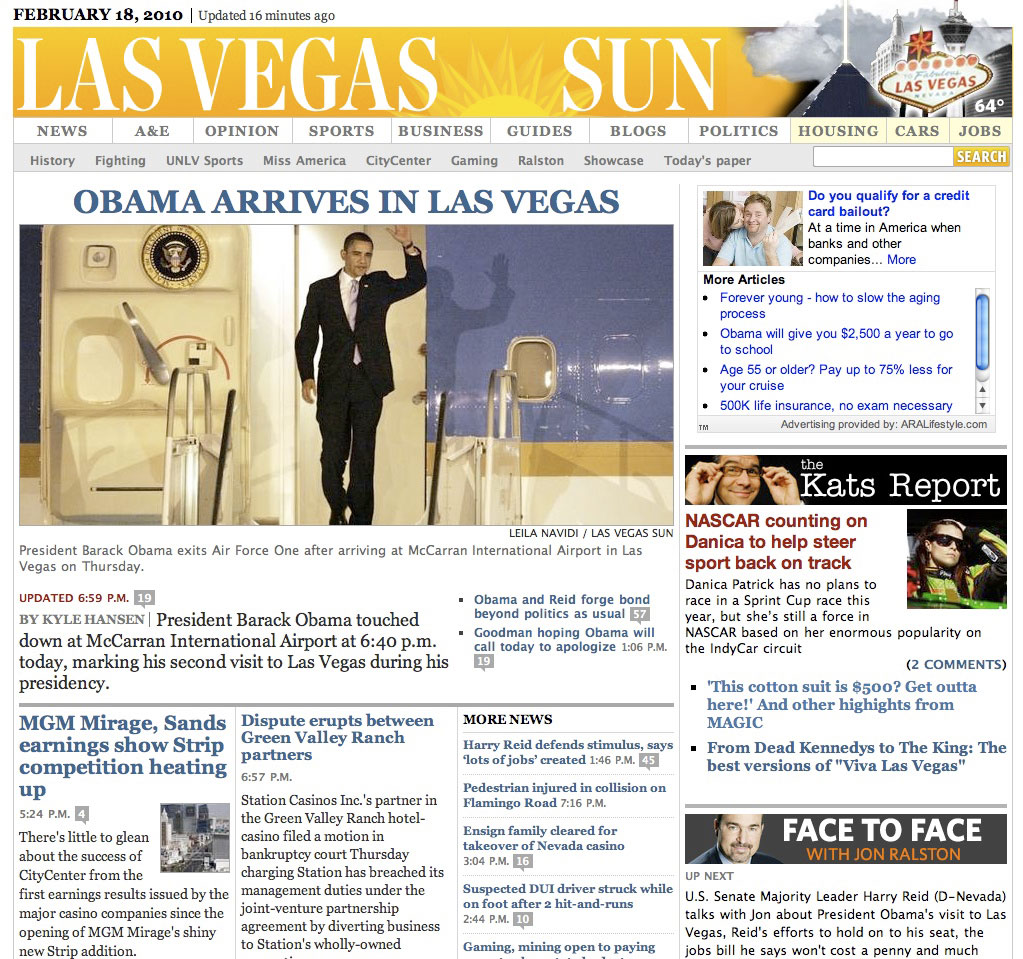
A few hours later we had live updates on slight delays for Air Force One, as two of our local/breaking news reporters (Kyle Hansen and Tiffany Gibson) tag-teamed the day’s text coverage. Photos by Greenspun newsroom photographer Leila Navidi were posted within minutes of his arrival, as our photographers post their shots directly into our online content-management system.

Our homepage was designed to give it all really nice play.

+++

+++

Then in Friday’s newspaper, we had the story from the Sun’s Washington correspondent Lisa Mascaro about what the president’s visit to Las Vegas was primarily about — a foreclosure program that would pump money into areas like Nevada that were hit hard in the housing crisis. Of course, the newspaper also had a teaser to direct readers to lasvegassun.com for updated coverage of Obama’s visit throughout the day.

Here’s what the front page of the print edition looked like that morning:

+++

Las Vegas Sun newspaper

+++

We had a reporter and a photographer at both locations where the president was speaking — as two of our news operation’s main political reporters (J. Patrick Coolican and Michael Mishak) both fed the Sun’s website with frequent updates of the speech. We also had reaction from D.C. from Mascaro.

That left us with a full story of the visit, five photo galleries (Obama’s town hall forum, his meeting with business leaders, his arrival, his departure and protesters) and embedded YouTube video of his entire speech.

Of course, all of that online coverage then was followed with the Sun print edition’s analytical coverage by Coolican and Mishak in the next morning’s newspaper.

At the last newspaper many members of our online team worked at, a presidential visit wouldn’t have been out of the ordinary. But 2,500 miles from D.C., we pulled out all the stops for Obama’s second visit to Las Vegas while in office.

+++

But just because the Sun had wrapped up its coverage of Obama didn’t mean we were done on that Friday night … well, it was more like early Saturday morning.

The new Cirque du Soleil show — Viva Elvis — had its world-premiere Friday. Our news operation is blessed to have a truly amazing arts reviewer, Joe Brown.

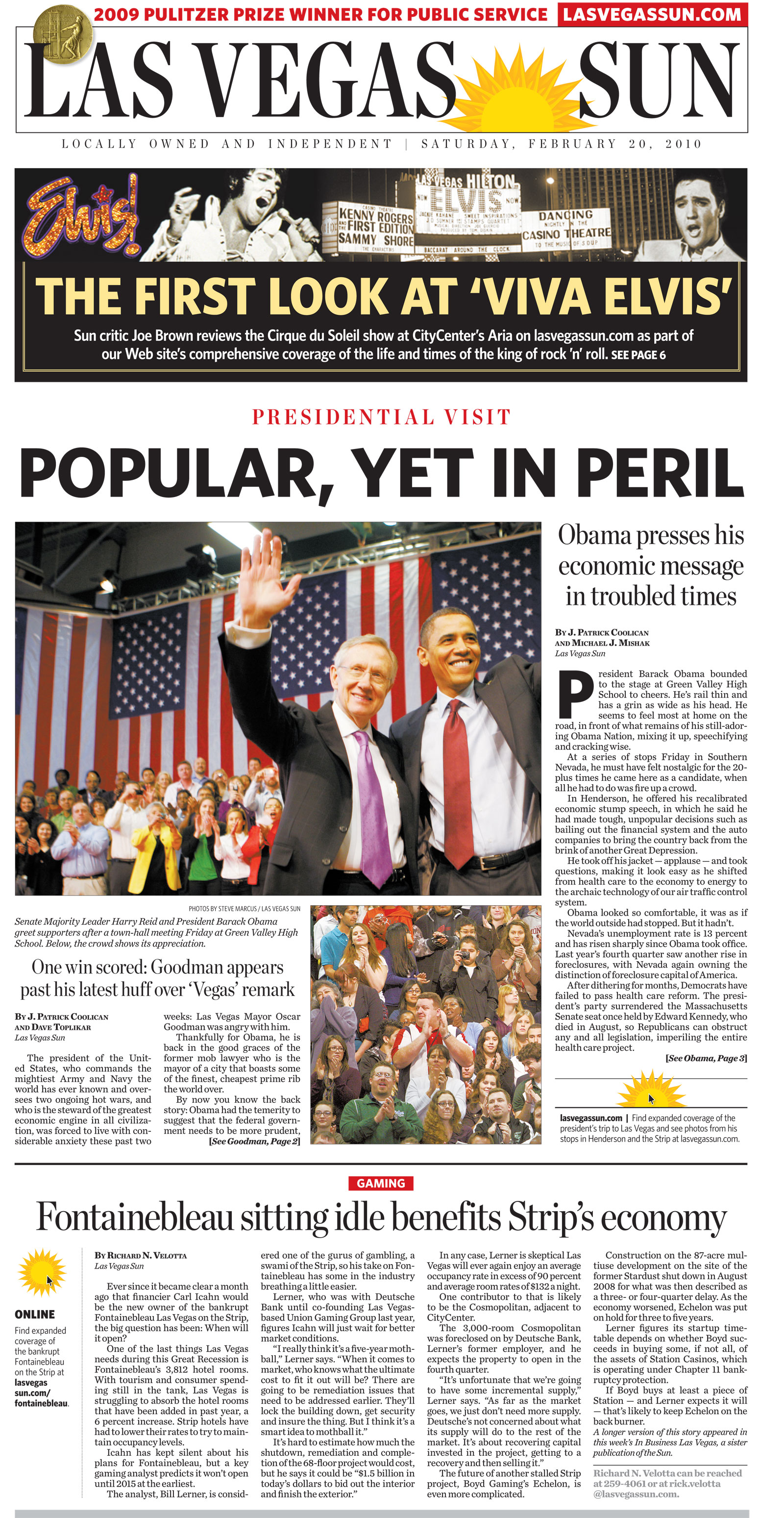
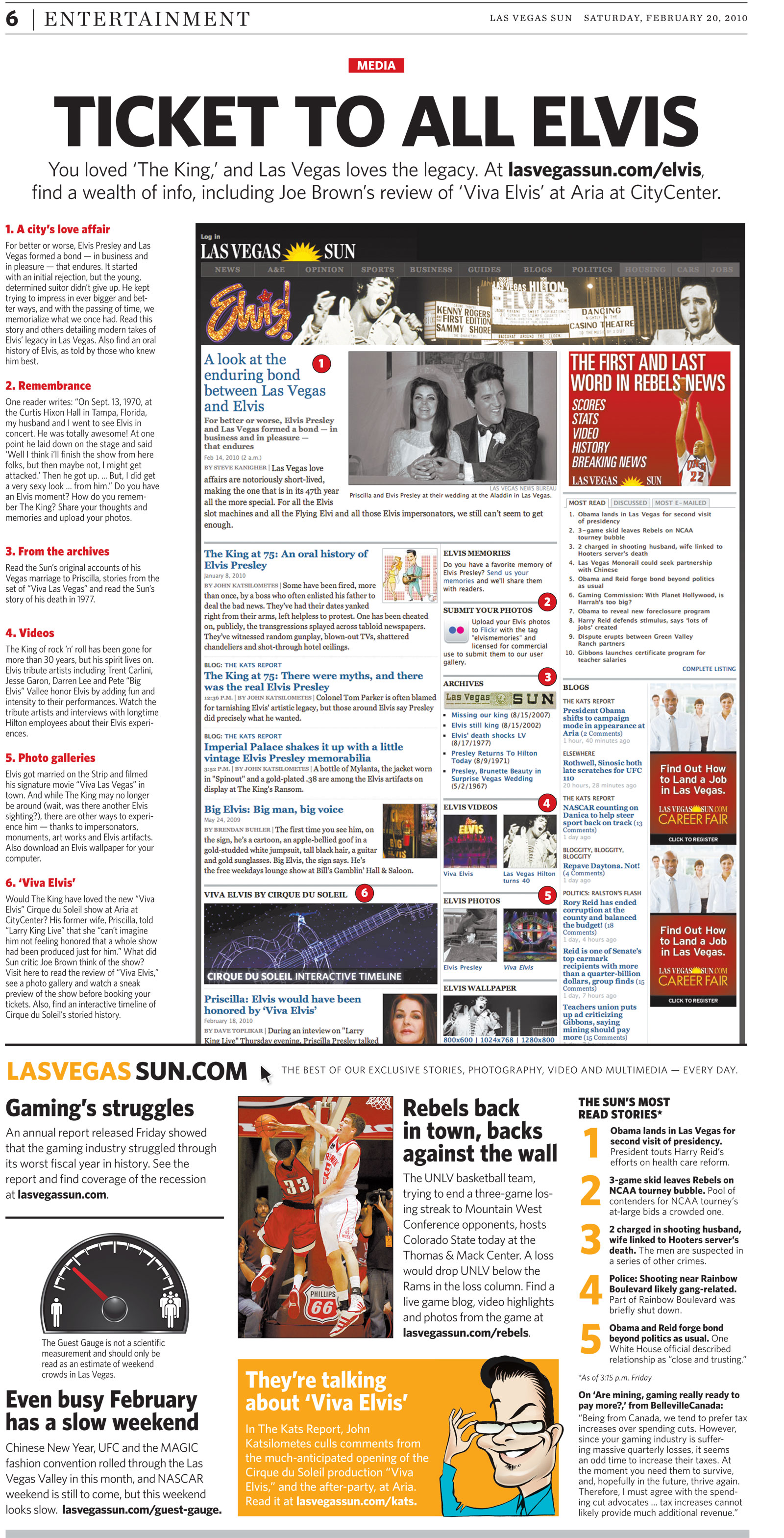
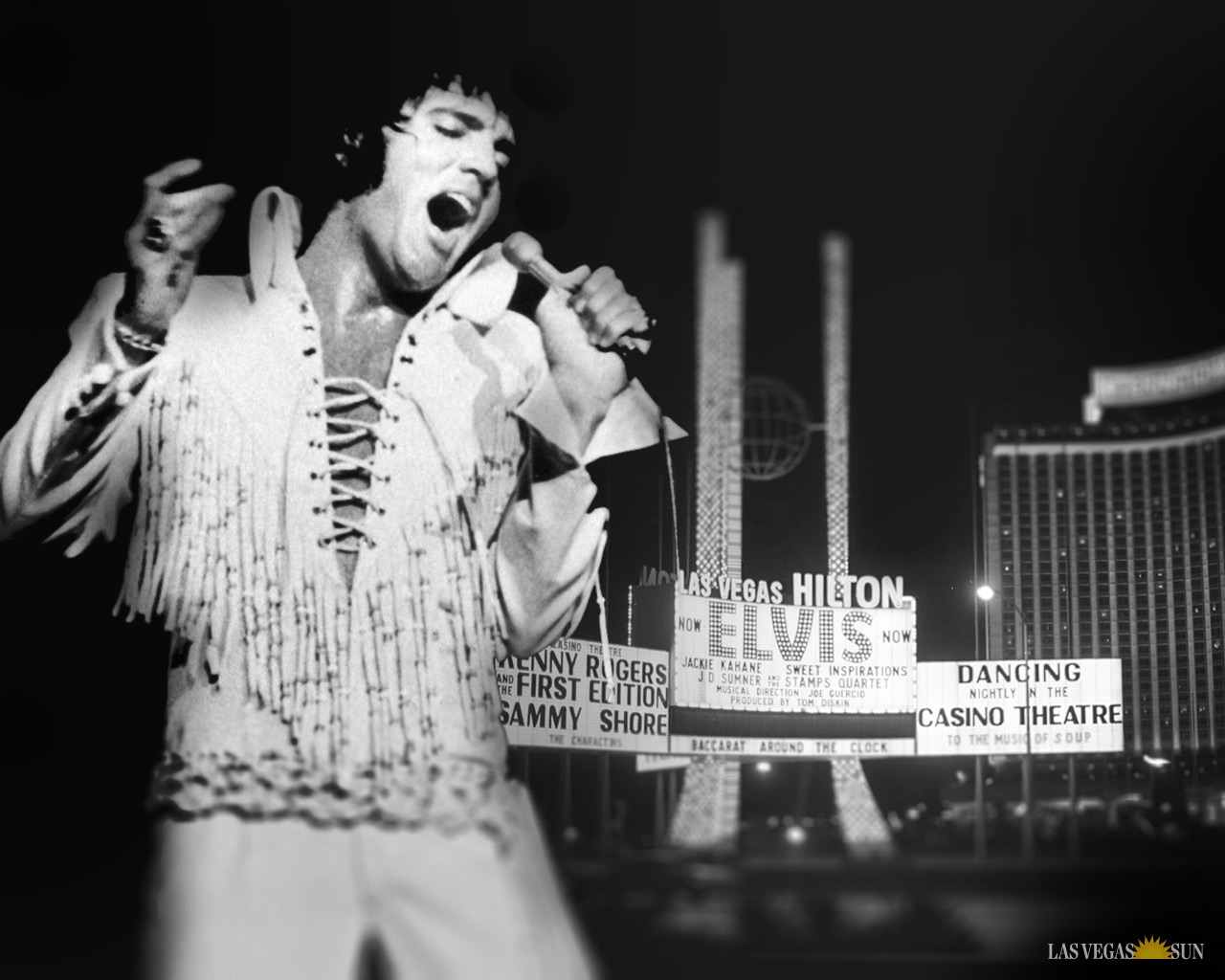
The front page of the next morning’s newspaper told our readers they could visit our site to see his first-look review of the show. (The Elvis photo illustration on the front of the Sun print edition was put together by our online senior designer, Danny Debelius.)

Just check out the prominence of this online refer in the print edition:

+++

Las Vegas Sun newspaper

+++

And it was worth it because the first Las Vegas publications to have a review of the show were the Sun and Las Vegas Weekly, via lasvegassun.com and lasvegasweekly.com. But this was about much more than just having it first. I know I’m about as biased as they come when it comes to things like this, but Joe’s review was easily the best of the bunch.

But all of this fiber-cyber synergy was nothing compared to the online refer that ran on the backpage of our print edition for our new Elvis section on lasvegassun.com. It basically was a user’s guide to the Sun’s huge site dedicated to the “King of Rock and Roll,” designed (and even written) by our newspaper’s lead print designer, Rachel Perkins.

+++

Las Vegas Sun newspaper

+++

Building a massive Elvis section on our newspaper’s website was an obvious thing to do; we just needed a good excuse to do it. The new Cirque show gave us the reason and a real deadline to get it launched.

Yes, we have all sorts of stuff in the section about the “Viva Elvis” show — including a great Flash timeline of how the Cirque empire came to be — built by Tyson Anderson and compiled by Melissa Arseniuk.

But just like with the new Cirque show, French-Canadian acrobats aren’t the star of the Sun’s Elvis site. It was built to try to explain Elvis’ unique — and seemingly inseparable ties — with Las Vegas.

The site opens with two incredibly informative and well-done stories by Sun veterans Steve Kanigher and John Katsilometes that explain the bond and history between Elvis Presley and Las Vegas, as well as why the connection continues.

My favorite parts of the site are:

* Memories of Elvis from our readers.

* Elvis photos from the public via Flickr.

* The most kick-ass downloadable Elvis wallpapers you’ve ever seen.

* Tons and tons of Elvis and Elvis-related photo galleries from our archives.

* Video overkill, including a great clip of what Elvis tribute artists think of the song Viva Las Vegas being used in Viagra commercials, as well as what the “blue carpet” looked like for the opening of the Cirque show. (Because of “Blue Suede Shoes,” there was a blue carpet instead of a red carpet.)

* And my absolute favorite part of the site: really fascinating-to-read stories from the Sun’s archives, like the Las Vegas wedding of Elvis and Priscilla. And Vegas’ reaction to Elvis’ death from the summer of 1977.

+++

And then came Saturday … gameday at the Thomas & Mack Center.

Sometime in the next few weeks, I am going to try to post an overview of our UNLV Runnin’ Rebels site and explain all of the strategies we’re trying to accomplish with it, but for the purposes of talking about a weekend full of cross-platform/multimedia journalism, I really can’t ignore our college hoops coverage.

On game day, it starts with Ryan Greene’s live game blog.

I’ve read lots of live coverage of sporting events, but I believe in my heart that Ryan is one of the best live-game bloggers I’ve ever seen. His posts are really insightful, very informative and have a ton of voice. And he’s typically right in the middle of the reader comments on the blog, answering questions and filling in details for our readers right there from press row.

But that’s not all he does during the game.

He’s also updating the Sun’s live Twitter feed.

And writing and publishing our live mobile-phone text-messaging updates of the game.

As soon as the game is over, our team’s sports editor Ray Brewer quickly posts something we call “Instant Analysis” — which gives our readers an almost immediate column about the game. It’s amazing how quickly it gets posted.

There are all sorts of postgame stories and notes packages written by Greene and other members of our sports staff, including Case Keefer, as well as a database-driven box score.

You’ll also notice that all of the players’ names in the stories click-through to their constantly updated bio and stat pages thanks to our evening online editor John Fritz.

Then there’s Christine Killimayer’s killer highlights and interview video package. Christine shoots the video, does the interviews, writes the script, does the opening stand-up and edits the whole package. It is 100 percent and all done on a same-day deadline.

http://media.lasvegassun.com/media/assets/swf/mvc_video_2.1.swf

From a photo standpoint, you get images published during the actual game from Justin Bowen, then a large postgame gallery that can be viewed full-screen.

And it’s all wrapped up with a postgame podcast that is produced by our editorial team in the arena.

What I love about all of this is how not only is it all tied together seamlessly (you can find everything I just outlined linked in each of that game’s stories), but also that it’s all produced on “Internet time.” These stories and packages weren’t posted on a print deadline because the print edition of the Sun doesn’t even have a sports section.

This was all content built specifically for the web.

+++

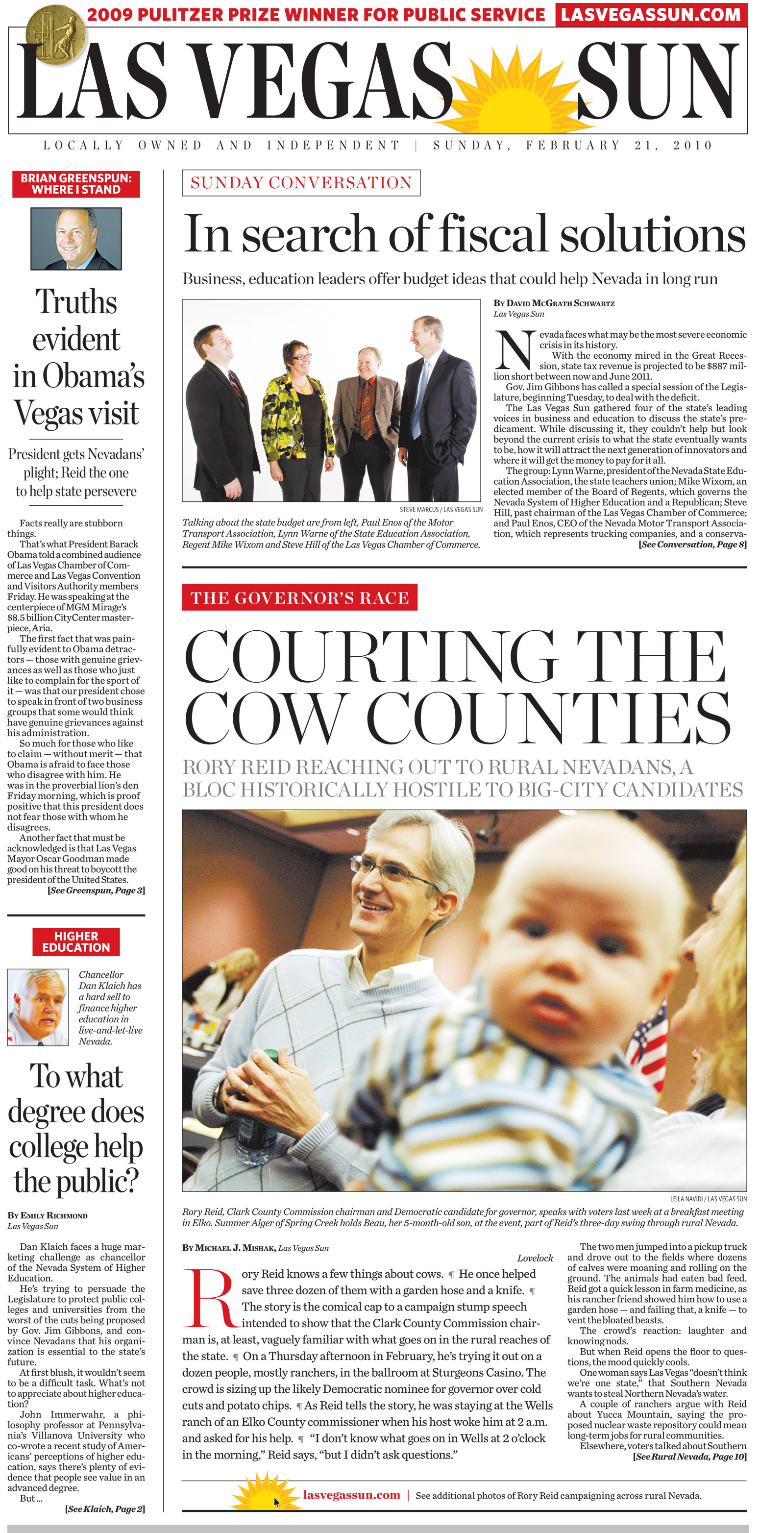
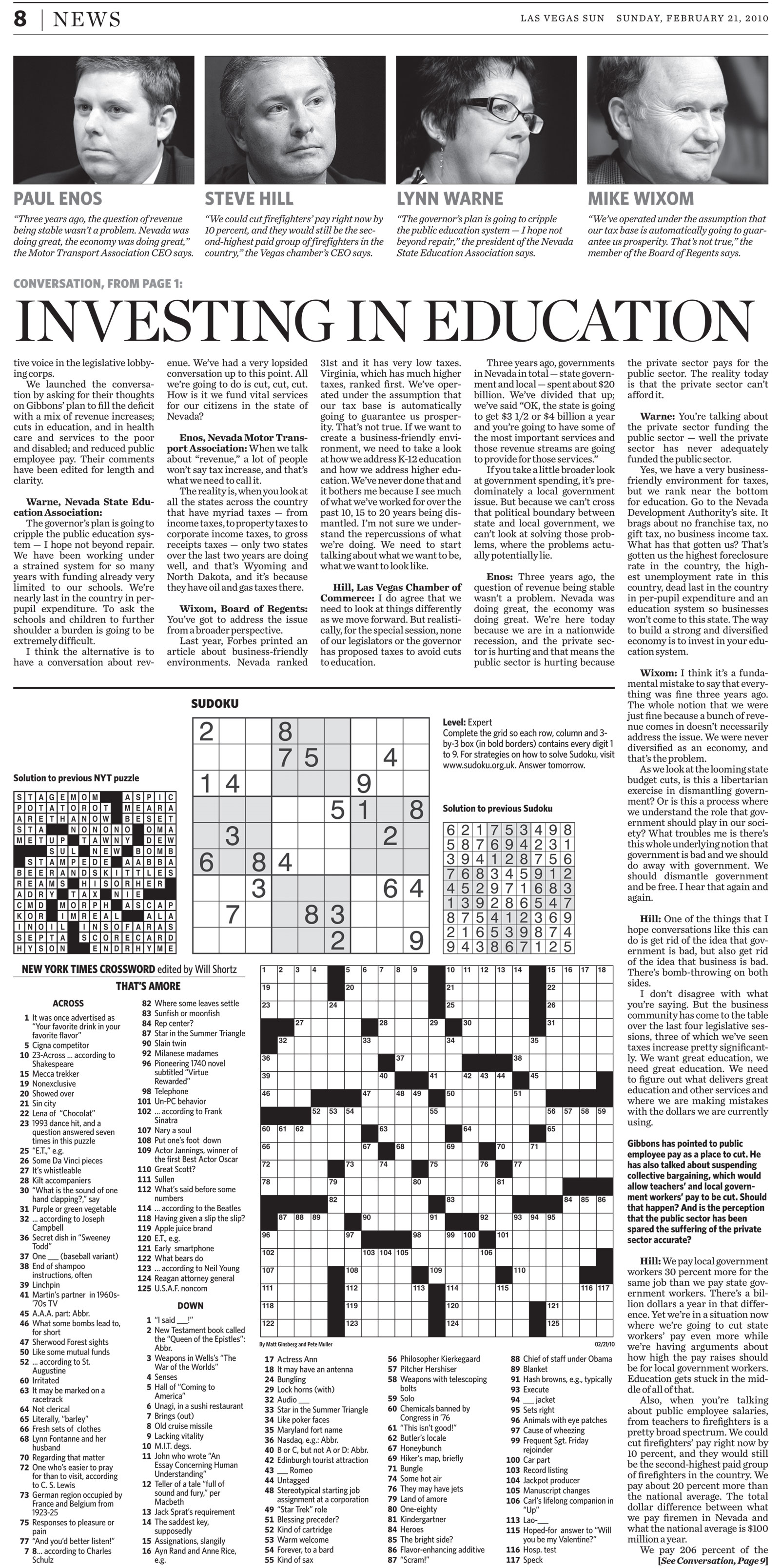
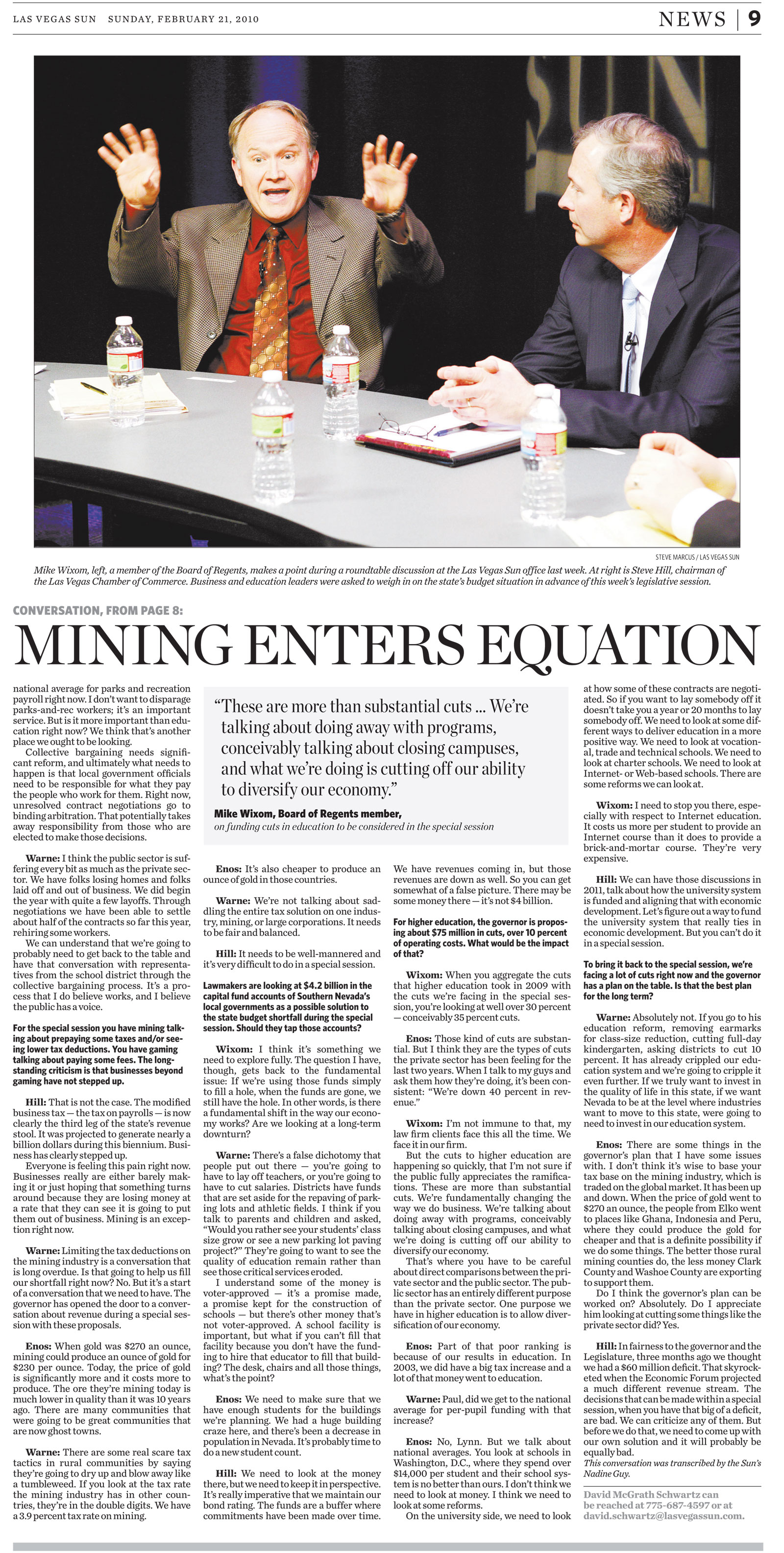
And in the Sunday morning print edition of the Las Vegas Sun, there was a feature we call “Sunday Conversation,” which is about as converged of an effort as anything our team has ever worked on.

It started with Sun political editor Michael Squires working with Sun political writer David McGrath Schwartz to pull together a roundtable interview of several leading political and business organizations to have a very frank conversation that gets to the real guts about what’s going on with the state budget, as well as the future of Nevada.

Once they were assembled in the Sun’s newsroom, Schwartz moderated the conversation while it was videotaped for both our website and to run in parts during our broadcast convergence partner’s newscasts — KVBC/NBC Channel 3.

What’s really cool is that Squires — the print editor — went through the complete transcript of the nearly 70-minute interview to select the five segments that would run statewide on television via KVBC and its sister stations throughout Nevada. The guy even wrote the intros to the clips.

The new Greenspun newsroom has a high-def studio and control room in it. Here are behind-the-scenes photos of us shooting this package, if you’re interested.

Here is how the video appeared on lasvegassun.com:

http://media.lasvegassun.com/media/assets/swf/mvc_video_2.1.swf

And here is how the project looked in print:

+++

Las Vegas Sun newspaper

Las Vegas Sun newspaper

Las Vegas Sun newspaper

+++

So, that’s what the Las Vegas Sun did last weekend. We don’t know if it’s the right or wrong way to approach things, but it sure feels a lot closer to right than it does to wrong.

And you know what’s really cool? We have almost equally crazy-huge plans for a bunch of events and stories this coming weekend.

NASCAR is town for a big race.

The Rebels are on the road in a must-win game.

And the Nevada Legislature is still meeting in special session.

This really is a great place to be practicing this type of journalism.

+++

To comment on this post, or to see comments about this post, please go here. (Requires Facebook account.)
Covering high-school recruiting. On a Sunday afternoon. Please meet Ray Brewer.

I’m a huge fan of Las Vegas Sun preps writer Ray Brewer and I love the way Brewer leads our coverage of high school sports in this valley. Plus, his enthusiasm and drive are contagious.

Other than Brewer, what also makes the Sun’s high-school sports coverage so unique is that it is online-only. As I’ve written numerous times before, because of the JOA in Las Vegas, our print edition only has eight pages each day — with no daily sports or entertainment content, except on rare occasions.

Before the fall sports season began, I posted a blog about our company’s high school sports strategy and how great Brewer is.

But if you want to see just how cool Brewer is, check out this video, or look at our overkill coverage of the state championship game that included: a huge preview section, a pre-game audio podcast with former Sun sports writer Steve Silver, an amazing game highlights video by Christine Killimayer, a great photo gallery from Justin Bowen and a game story that not only integrates all of these different types of content, but also seamlessly integrates lasvegassun.com’s amazing database content for both teams and every player on each team.

The point of all of this is that Brewer helps epitomize one of our news organization’s stated goals, which is not to just publish on the web, but to be *of* the web. From the very top of our organization, new-media publishing is anything but an afterthought.

And Brewer helped reiterate all of this today … as well as showed again just how frickin’ webby he is.

All weekend, Ray has been all over the local recruiting scene and breaking stories left and right. And when I say Brewer has been breaking these stories, I don’t mean that he’s been beating our other local media competitors.

Ray understands that in the world of recruiting news, the other local newspaper and television stations in Las Vegas aren’t our competition. The competition are the other sites dedicated specifically to this type of information — like Rivals, Scout, etc…

Look at the story Ray broke today. What makes it so dang interesting to me from a new-media journalism perspective isn’t just that he had the story first (which he did), but how he integrated so many other online storytelling elements.

There are video clips. There are links to the players’ profile/stats pages. There are links to other relevant stories (picked by an actual journalist, not some haphazard automated process). And then you have Brewer right in the middle of the story’s reader comments becoming a part of the community dialogue.

This is how you pull together live/daily content with smart implementation of evergreen databases and practical use of other related content from your news organization’s archives.

And you don’t just do this for the big stories. You do it for every daily story where it can be accomplished.

He first published a version of this recruiting story at about 11:45 Sunday morning and continued chasing parts of it and updating it throughout the rest of the day, including a major update to the story by about 8:45 in the evening. By that time, the story had been elevated to the centerpiece on our homepage.

The ink was never dry.

What’s really cool is that this is just how Ray Brewer thinks. He did almost the exact same thing with another recruiting story yesterday — and that one had pretty big national interest.

My favorite part is that Ray did all of this on “internet time,” not on “what-is-my-deadline-to-get-this-in-tomorrow’s-newspaper?” time.

At the Sun, we know Ray is going to get beat on a story from time-to-time, but we also really like knowing he’s *our* high-school sports reporter.

And today sure felt like a text-book example of how to cover high-school recruiting in 2010 if you’re a local news organization that — as our publisher at the Lawrence Journal-World used to say — is driving with your brights on.

+++

To comment on this post, or to see comments about this post, please go here. (Requires Facebook account.)

Real-time news in Las Vegas: The Federal Courthouse shooting

Sorry about the lack of posts lately.

Any way you slice it, there have been lots of things going on … with our company, with the holidays, and lots of huge events and big breaking news here in Las Vegas. I’m eventually going to try to write about all of those things.

But for today, I want to quickly focus on how our week began at the Las Vegas Sun.

On Monday morning, a gunman opened fire at the Lloyd D. George Federal Courthouse. I found out about this story as I was getting ready to head in to work. An alert came across my iPhone via the CNN app.

My first response was something like, “holy crap, I hope we know about this.” But the reality — at least from an online news editor’s perspective — was even better than that: Not only did we know about it, but we had already posted a story about it.

Sometime throughout all of this, I posted a link to our coverage about the shooting on my Facebook and Twitter pages.

Our coverage was not only very thorough, but very multimedia-based. Later that day, I got a question via Facebook about how we went about covering this event and how big our online staff is. My response to that question is essentially below:

+++

Technically, all of our company’s publications — print and online — share one newsroom. But for the most part, folks are primarily assigned to one publication/topic, with lots of overlap.

Our converged newsroom does the content for the print and online versions of the Las Vegas Sun newspaper and the Las Vegas Weekly entertainment magazine, as well Vegas magazine (high-end luxury) and Las Vegas Magazine (which is the tourist magazine found in basically every hotel room in Vegas). In Business, which is a weekly business newspaper, also is produced by the Greenspun Newsroom.

Because of the unique JOA in Las Vegas, the print edition of our newspaper does more news-magazine-type journalism. It rarely does “daily” stories. That means breaking news on our newspaper’s website comes from basically a different group of journalists who focus on daily/breaking news.

But — as I mentioned earlier — there is a ton of overlap on a daily basis.

Our news operation has 12 writers dedicated primarily to the print mission of the Las Vegas Sun. Our online news operation has three full-time reporters, as well as two interns who essentially operate as full-time reporters. We have three online editors — two dayside, one nightside. One designer. One Flash developer. And two dedicated news videographers.

We average almost 30 locally originated “breaking news” stories each day on the lasvegassun.com website and that doesn’t happen without significant help from the writers who also write primarily for the Sun’s print mission. The other side of that is that different versions of stories originally written for our website’s daily news strategies sometimes not only end up in the print edition of the Sun, but sometimes even lead it.

We also have a new-media special projects editor who helps us put together a pay Nevada politics newsletter, writes lots of stories and fills in as our online editor whenever needed.

We have three full-time, new-media sports reporters, along with two full-time sports interns. We also have one full-time sports videographer.

Our converged newsroom has five photographers who shoot for basically every print and online publication our company owns.

So, back to the question …

The news side of lasvegassun.com is basically three full-time reporters, three editors, two videographers and a few interns.

The coverage of the courthouse shooting was handled by our online managing editor, Tim Richardson.

Tim first posted the story about the shooting at 8:43 in the morning after hearing from a reporter primarily dedicated to the print mission of the Sun that something big was apparently happening downtown. Tim called the cops to find out what was going on and then posted four paragraphs.

From that point, we got our online courts reporter involved and sent two of our online interns to the scene.

A photographer and videographer were sent to the scene, as well.

A “print” reporter (and I’ve got to be careful using that term because it will likely get me in trouble with our operation’s leadership) also helped fill in some of the details, as did the editor of our weekly business paper … who also is probably one of the most online proficient “traditional” newspaper people I’ve ever met in my life. He just “gets” the internet, and uses it not only as a powerful and immediate publishing tool, but also in his research and reporting.

(Look, I know it seems a little dated to use a term like “gets the internet” when describing a journalist in a 2010 mainstream-media newsroom, but it still seems appropriate and accurate in this instance.)

The text, photos and videos for the story were updated throughout the day on our site. The updates were constant. As were the comments to the story.

Sometimes updates came via phone calls and text messages from our journalists, and sometimes via e-mail.

As soon as cell phone video of the shooting hit YouTube, we embedded the video into our story.

So, what we got was coverage produced 100 percent for lasvegassun.com. None of the content that you see in the links above appeared in the print edition of the Las Vegas Sun.

The print edition of the Sun had a “second-day” story about how the George Federal Building in downtown Las Vegas was the first such facility in the nation to be designed to standards to withstand the kind of lethal blast that buckled the Alfred P. Murrah Federal Building in Oklahoma City in 1995.

The front page of the Sun looked like this the following morning. Because our print edition doesn’t behave like a paper of record, you’ll notice that our story about the shooting is on the bottom of the front page.

For stories like this, it’s always interesting to be in our combined news meetings each morning. If there is a story that we feel needs to be in our print edition, but we’re certain that our competitor will have something on the same subject, then our thought processes turn to what will be an angle that the other newspaper in town likely won’t have.

That’s why our print story is played the way it is played on the front page and why it isn’t a story about the details of the shooting, but instead about the security at the courthouse.

+++

To comment on this post, or to see comments about this post, please go here.

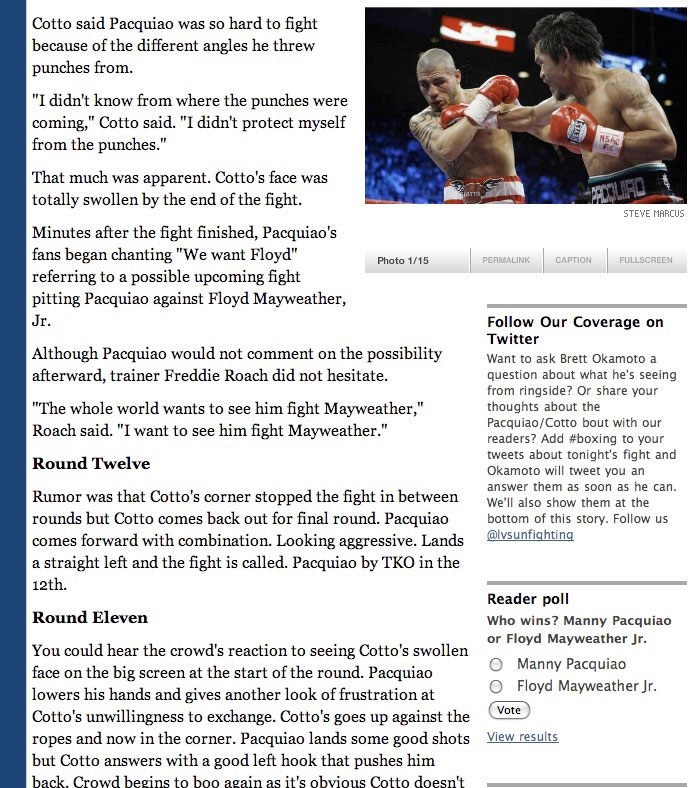
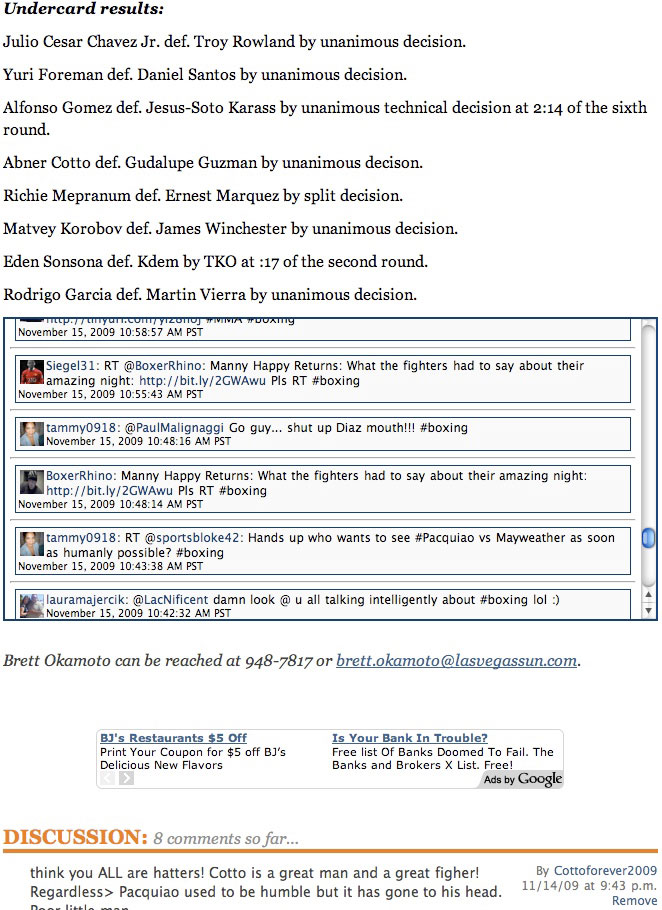
Pacquiao-Cotto fight: Twitter, live blogs, multimedia and general wiliness as a part of beat coverage

For a kid who grew up in Kansas with beef, basketball and Bob Dole, things like boxing and UFC are a little out there for me. But I have to admit that I enjoy them. And it’s obvious that a whole lot of lasvegassun.com readers love them, as well.

As I have written about before, UFC seems very much like Las Vegas’ major-league sports franchise to me.

And though its relationship is different with the city, boxing absolutely has the same vibe to it.

I know that with just about 18 months under my belt I’m very much a newbie to Nevada, but I still love to go to the Strip on Fight Night because the atmosphere in Vegas when a championship fight is in town is a little like being in Lawrence during the Final Four — only it’s more than just kids who grew up in the Great Plains.

The diversity you see in Las Vegas for big fights is amazing and completely cool. And the diverse ways we try to cover Fight Night in Vegas is equally cool to me.

Las Vegas Sun coverage of Pacquiao-Cotto fight

We definitely pull out all the stops, and the traffic numbers to this content are through the roof.

For this past weekend’s Pacquiao-Cotto fight, lasvegassun.com broke every weekend record we had and even through Monday evening our fight coverage was still the most-viewed content on our site.

I’m going to go into our pre-fight coverage in more detail a little later this week with a blog entry about video on newspaper sites, so, for the purposes of today’s post, I’m going to focus more on the 12 hours before the fight and the 12 hours after last weekend’s big boxing title fight.

Along with Las Vegas Sun print reporter Jeff Haney and photographer Steve Marcus, we had three new-media journalists at the fight: Brett Okamoto, Ryan Greene and Christine Killimayer.

On the new-media side, Brett and Ryan handled the live coverage duties — Brett kept the live blog updated (which was the most-read story on our site all weekend) and Ryan kept our Twitter feed humming.

Here is a look at the blog page where you can see how we referenced our Twitter feed:

+++

Las Vegas Sun coverage of Pacquiao-Cotto fight

+++

Here is a look at how we integrated the live Twitter feed directly into our live blog page:

+++

Las Vegas Sun coverage of Pacquiao-Cotto fight

+++

And here is a look at our fighting page on Twitter:

Las Vegas Sun coverage of Pacquiao-Cotto fight

+++

But it was the Sun’s post-fight coverage that really kicked some serious backside. And it worked on all levels — the right stories along with extremely well-done multimedia (video, photo, audio) that crossed platforms, with great reader interactivity (poll, comments, etc…) … all done in an incredibly timely fashion.

This was news coverage that was “of” the web, not just posted “on” the web.

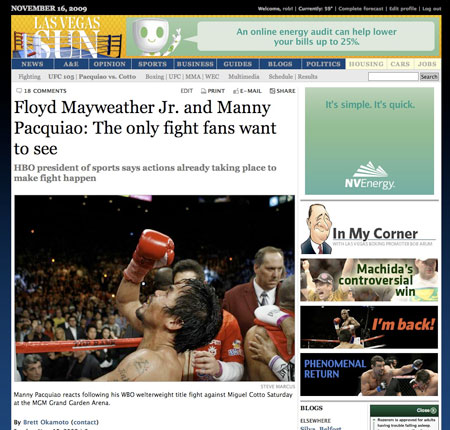
First, there was Brett Okamoto’s amazing lead story — which wasn’t really a traditional post-fight story. In the print world, it would likely be called a “second-day” story, but because Brett had been live-blogging the entire fight, the fight had been covered.

Thoroughly.

The real story was what would happen next, and Brett instinctively knew that was the story we should be telling.

+++

Las Vegas Sun coverage of Pacquiao-Cotto fight

+++

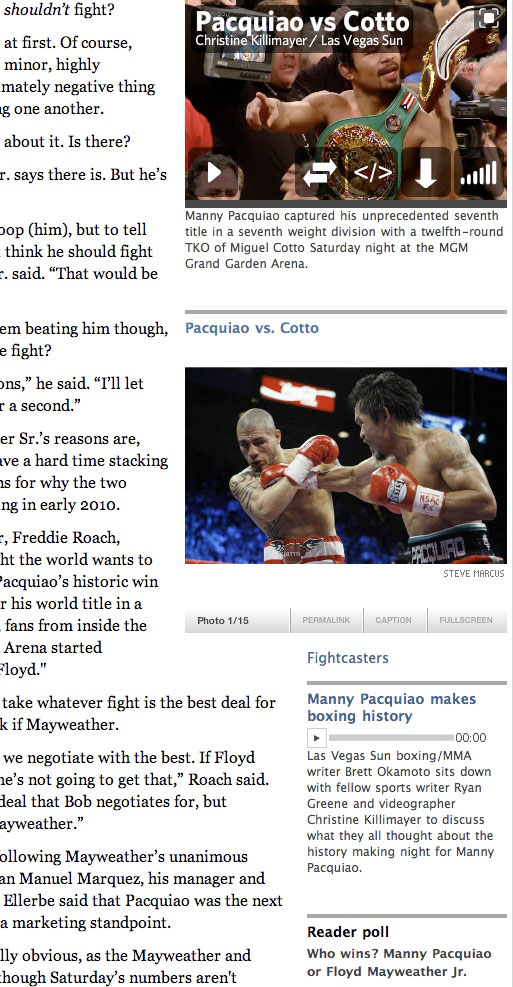
Now, look at the above story’s online story page and see how all of the multimedia elements are so prominently played on it:

+++

Las Vegas Sun coverage of Pacquiao-Cotto fight

+++

So, you have Brett’s very well-done story.

Then layer in Christine Killimayer’s amazing fight video.

+++

http://media.lasvegassun.com/media/assets/swf/mvc_video_2.1.swf

+++

Then layer in that the Sun probably has one of the best boxing photographers in the country with Steve Marcus, and you have photos that really help tell the story. Plus, they just look frickin’ cool.

And finally, layer in the Sun’s post-fight audio podcast — which was posted hours before anyone actually received their Sunday newspaper and featured Brett, Ryan and Christine talking in-depth about the the fight.

+++

I’m no futurist. That being said, no one can tell me that in a world where ESPN is now trying to take over newspapers’ local sports franchises that our industry’s online coverage shouldn’t be looking a helluva lot more like what is outlined above.

Or at the very least, like KUsports.com’s coverage of the Kansas Jayhawks, circa 2004.
πŸ™‚

As Las Vegas Sun president and editor Brian Greenspun said about a year ago, in the future he hopes people might say “My God, the Las Vegas Sun was so much closer to right than they were to wrong, and we all better jump on board.”

+++

To comment on this post, or to see comments about this post, please go here.

Using evergreen databases and guides with weekly narrative content

Our team has always been known for building lots and lots of databases. Or at least we get asked about them a lot.

Though we’re probably best known for our sports databases, some of my favorites from the past have been things like our restaurant health-inspection reports and state legislature voting records from our time at The Topeka Capital-Journal in the early part of this decade.

Don’t try to find those DBs — they’re long gone from cjonline.com. 😦

I’ve long said that five things really push traffic on the web: content that people are passionate about, practical information, playful/fun things, personal communication and porn.

The databases that we build that typically get the best traffic fall under the category of practical information — things like a great local calendar, killer restaurant overviews, huge club guides, the biggest and best casino guides out there, etc…

But one of the problems that we have with these databases is that it’s sometimes hard to call attention to them.

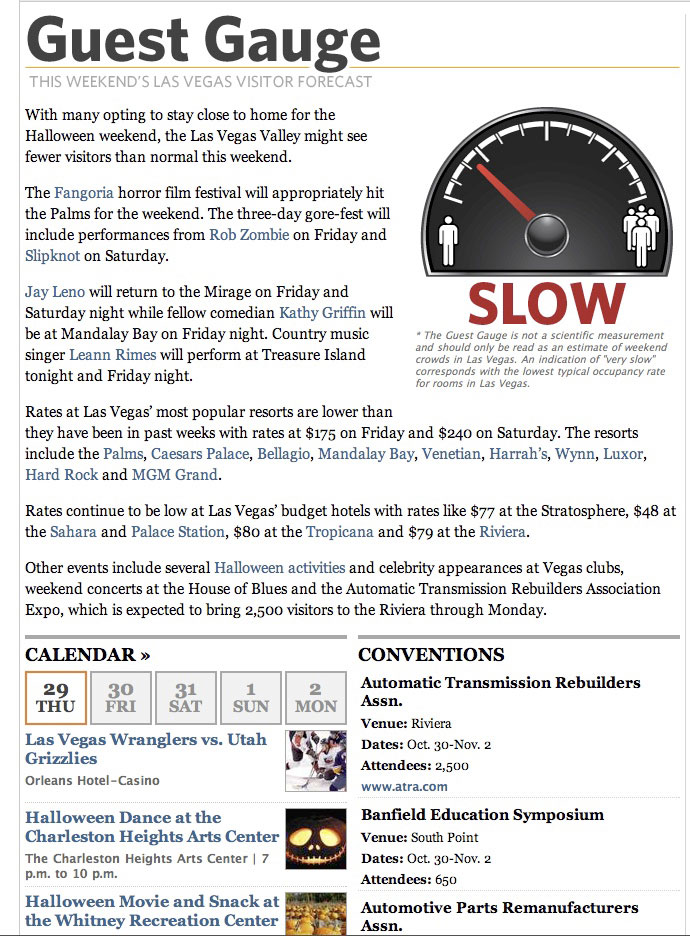
One of the ways that we now try to play them up on lasvegassun.com is with something we call the Guest Gauge.

The Guest Gauge was originally going to be called the Strip Gauge, but after lots of talk with lots of people, it was decided that it was more than about the Strip and that name might actually tick off the LV locals — and the people who live here are actually part of the target audience for this feature.

One of the reasons we wanted to have this was so people who lived here wouldn’t be surprised if they ventured over to the resort corridor with visitors or to go to a restaurant or something like that, and then be hit with a huge crowd when they know CES isn’t in town. We also built it because Las Vegas fills with folks from Southern California every weekend and many of those people decide at the last minute if they’re coming or not.

And the biggest reason we built it was because content like this is right in our sweet spot. When we write about things like this, we get traffic because people are interested in it.

Then layer in that something like this didn’t take a lot of technical resources to build and it helped us indirectly point to our databases, well then you can see why we did it.

As for the narrative content inside the Guest Gauge, Amanda Finnegan — who focuses on developing content related to the gaming industry that doesn’t necessarily have a home in our company’s print editions — does it by checking daily hotel rates, combing through our calendars, researching which conventions are in town and how big they are, and checking in with people who can tell us how busy they think Vegas will be for the upcoming weekend.

In addition to noting the biggest conventions and providing deep links to our casino and calendar databases, we provide weekend room rates at some of Las Vegas’ major luxury resorts, as well as budget properties.

Using this data from several sources, we determine whether we think the city’s resort areas during the weekend will be very busy, busy, average, slow or very slow. We also note in a disclaimer that a “slow” weekend in Las Vegas would still indicate occupancy levels that any other city across the country would love to have.

The design for the page and the homepage implementation was done by the Las Vegas Sun’s online design guru Danny Debelius, while the back-end integration was done by Greenspun Interactive’s extremely talented Elliot Burres and software developer Chris Mason.

The Guest Gauge isn’t on the Sun’s homepage every day. It’s just there Thursday through the early part of Sunday. And while it carries a disclaimer stating that the Guest Gauge isn’t scientific, we do have evidence that we think shows it’s mostly accurate: a major casino executive recently told us we’re right on.

We’ve been doing this for nearly two months. So far, the traffic to it has been good but not great … and probably lower than we had hoped.

On the other hand, this kind of falls under the idea of “fail often and fail fast” and try to do it on-the-cheap. We don’t have a ton of resources invested into it and the potential for upside is definitely there.

We’ll see.

Either way, the Guest Gauge definitely helps us get attention to our immense evergreen databases and guides.

+++

Here is how the Guest Gauge looks on our homepage — look in the right-hand rail:

Las Vegas Sun Guest Gauge

+++

And here is how the actual Guest Gauge pages have looked over the last three or four weeks, showing what it looks like when Las Vegas is both busy and not so busy.

Las Vegas Sun Guest Gauge

+++

Las Vegas Sun Guest Gauge

+++

Las Vegas Sun Guest Gauge

+++

To comment on this post, or to see comments about this post, please go here.

How a ‘traditional print journalist’ can become a great new-media journalist and still not know Flash or how to edit video

When I originally started writing this blog entry, I typed “U2 comes to the desert: Covering a mega-concert via new media” as the headline in the WordPress title box. And that’s what this post was going to be about — how John Katsilometes covered U2’s recent concert in Las Vegas.

To say I was impressed with how Johnny Kats covered it is a huge understatement. As I have written before, this guy impresses me a whole lot of the time, and I literally think he represents a major facet of how local journalism can/will survive.

But as I looked at his coverage of the U2 concert, I realized something else was going on there.

Our web team at the Las Vegas Sun is typically associated with mega-huge databases or over-the-top multimedia packages or the biggest breaking-news event coverage you’ve ever seen. However, lately we’ve really been focusing in on how to use new media to tell daily stories. On deadline. In real-time.

That’s how John covered U2 — using lots of new-media tools and philosophies and never once opening Photoshop or Final Cut Pro.

It was simple, effective and extremely webby. And it wasn’t published in a print edition three days after the concert was over.

It was for, and — more importantly — of the web.

John had posted a couple pre-concert blogs about the U2 show, including this one on some of the band’s previous shows in Las Vegas.

Then Kats’ gameplan was to cover that evening’s U2 show by spending lots and lots of time with the folks at UNLV who were in charge of the show, via Sam Boyd Stadium.

He was armed with his notepad, BlackBerry and digital camera.

His coverage began — and continued through the entire night — with constant updates on Twitter.

+++

Tweets from the U2 concert at Sam Boyd Stadium

+++

Throughout the entire night, John was taking photos on his phone’s camera. They were oftentimes immediately posted, like this shot of UNLV’s stadium director Daren Libonati as the final touches are being placed on U2’s stage.

U2 claw

So after all of the tweeting and reporting was done, John began writing his story. When that was completed, he posted the story himself into our organization’s online publishing system.

This kind of stuff does not freak out John. He gets right into our site’s content management system to not only post the story, but to add and move around the story’s other elements — like photos.

UNLV jersey for Bono

Yes, it’s a certain amount of technical acumen, but it’s more than just being comfortable with computers. John can write. He loves to tell stories. It’s that love of storytelling that is at the core of what he does.

What makes what John does so brilliant is that he can do it so effectively and in such an entertaining way whether he’s writing a quick four-paragraph blog for one of our Web sites or a 5,000-word story that ultimately ends up in print or 140 characters in Twitter.

And it all works. Each element can work singularly or as a body of work — doing it mostly with words. Not Flash. Not self-shot and self-edited video. The guy couldn’t write a line of programming code if you held a gun to his head.

But he doesn’t need to.

He’s a storyteller who not only isn’t afraid of new-media, but embraces it.

John Katsilometes is proof positive that you can still be extremely effective in this new world with old-school skills. I know I must sound like a frickin’ broken record, but it really is all about mindset.

I have seen this before. Back when I was at The Washington Post, I posted a blog about Post sports writer Barry Svrluga (then the Nationals beat writer and now the Redskins beat writer) and how he was navigating all of the change in our industry incredibly well.

So, how can a traditional print journalist stay relevant through all of this crazy change?

There isn’t one recipe.

But my gut tells me the soup tastes a whole lot like what these guys are cookin’.

+++

To comment on this post, or to see comments about this post, please go here.